
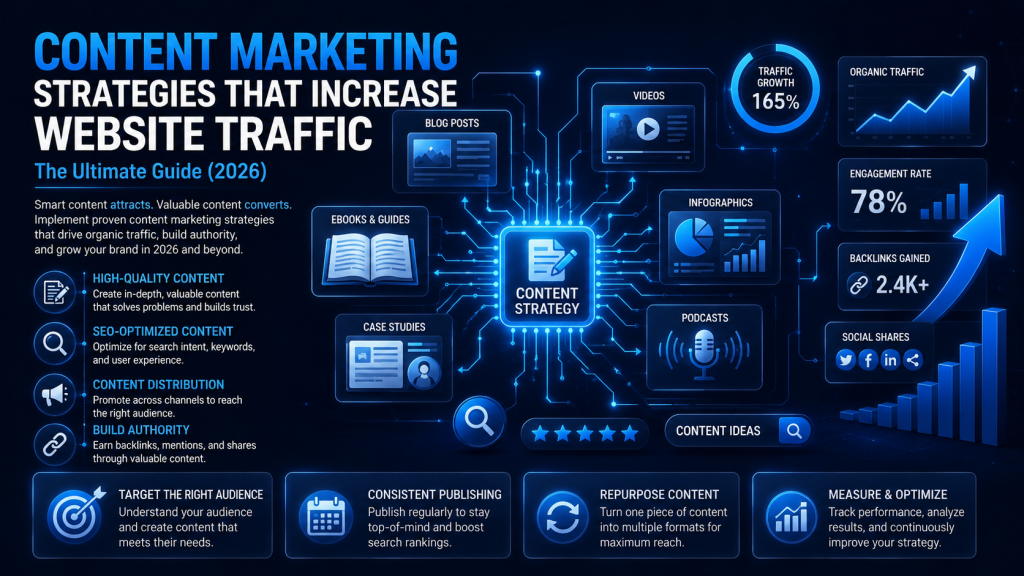
Content Marketing Strategies That Increase Website Traffic: The Ultimate Guide (2026)
Introduction Every business owner asks the same question at some point: how do you get more people to visit your website without spending a fortune on ads? The answer, for most brands that succeed online in 2026, is content marketing. Content marketing is the practice of creating and sharing valuable, relevant material such as blog posts, videos, guides, and infographics to attract, engage, and retain a clearly defined audience. Quality content matters more than ever this year because search engines, especially Google, now reward genuinely helpful information over thin, keyword-stuffed pages. With AI Overviews reshaping search results and audiences growing more selective about what they read, brands that publish consistent, trustworthy content win the long game. Content marketing strategies that increase website traffic don’t rely on quick tricks; they compound over months and years, turning a handful of well-optimized articles into a steady stream of visitors, leads, and customers. In this guide, you’ll learn what content marketing really means, why it drives sustainable traffic growth, the top 15 content marketing strategies that increase website traffic, common mistakes to avoid, the latest trends shaping the industry, and the tools professionals use to get results. What is Content Marketing? Content marketing is a strategic approach to creating and distributing valuable, relevant, and consistent content to attract and retain a clearly defined audience, ultimately driving profitable customer action. Unlike traditional advertising, which interrupts people with a sales pitch, content marketing earns attention by solving problems and answering questions first. This distinction matters because audiences today are skeptical of overt advertising but receptive to brands that genuinely help them. A billboard or a paid banner asks for attention; a well-written how-to guide or an in-depth comparison article gives value before asking for anything in return. That single shift, from interrupting to informing, is what allows content marketing to build lasting trust and authority. Over time, a business that consistently publishes helpful content becomes the go-to resource in its niche. When readers repeatedly find useful answers on your website, they begin to trust your brand’s expertise, and that trust naturally extends to your products and services. A Practical Example Imagine two competing accounting software companies. Company A only runs paid ads promoting its features. Company B publishes weekly blog posts on topics like “How Small Businesses Can Simplify Tax Filing” and “Common Bookkeeping Mistakes to Avoid.” Over a year, Company B’s articles start ranking on Google for dozens of relevant searches, bringing in thousands of free visitors every month, many of whom convert into paying customers because they already trust the brand’s expertise. Company A keeps paying for every single click. This is the compounding advantage of content marketing. Why Content Marketing is Important for Website Traffic Content marketing isn’t just a nice-to-have; it’s one of the most cost-effective ways to grow website traffic sustainably. Here’s why it matters so much for driving visitors to your site. • Improves organic search rankings by consistently targeting keywords your audience is searching for• Increases website visitors as more pages become discoverable through search engines• Builds brand awareness by putting your name in front of people at every stage of their research• Generates qualified leads by attracting people who are actively looking for solutions you offer• Improves customer trust because helpful, accurate content signals genuine expertise• Supports broader SEO efforts by creating natural opportunities for internal linking and keyword coverage• Encourages social sharing, which extends your reach beyond your existing audience• Delivers long-term ROI, since a single well-optimized article can attract traffic for years Consider HubSpot, a company that built much of its early growth on free blog content and downloadable guides rather than paid advertising alone. By answering the exact questions its target audience was typing into Google, it turned its blog into one of the biggest traffic-generating assets of the entire business, a pattern now replicated by countless companies across industries. Top 15 Content Marketing Strategies That Increase Website Traffic Below are the 15 most effective content marketing strategies for driving consistent, long-term traffic growth. 1. Understand Your Target AudienceEvery successful content strategy starts with a clear picture of who you’re writing for. Audience research involves studying demographics, pain points, goals, and online behavior so you can create content that genuinely resonates.Building detailed buyer personas, fictional profiles representing your ideal customers, helps you make consistent decisions about topics, tone, and format. Just as important is understanding search intent: are readers looking to learn something, compare options, or make a purchase? Matching your content to that intent is what separates articles that rank from articles that don’t. 2. Perform Keyword ResearchKeyword research is the foundation of any content marketing strategy that increases website traffic. Short-tail keywords (like “content marketing”) are broad and highly competitive, while long-tail keywords (like “content marketing strategies for small businesses”) are more specific and easier to rank for.Understanding search intent, whether a searcher wants information, a comparison, or to make a purchase, ensures your content matches what people actually want. Keyword clustering, grouping related keywords under one comprehensive piece of content, helps you rank for dozens of variations with a single article. Tools like Google Keyword Planner and Ahrefs make it easy to uncover search volume, difficulty, and related terms. 3. Create High-Quality, Helpful ContentGoogle’s guidelines increasingly reward original, people-first content. This means your writing should reflect real experience, expertise, authoritativeness, and trustworthiness, commonly known as EEAT.Rather than rehashing what’s already ranking, aim to add a unique perspective, original research, or practical examples. The goal is always to solve a genuine problem or answer a real question your audience is asking, not simply to hit a word count.