
Introoduction
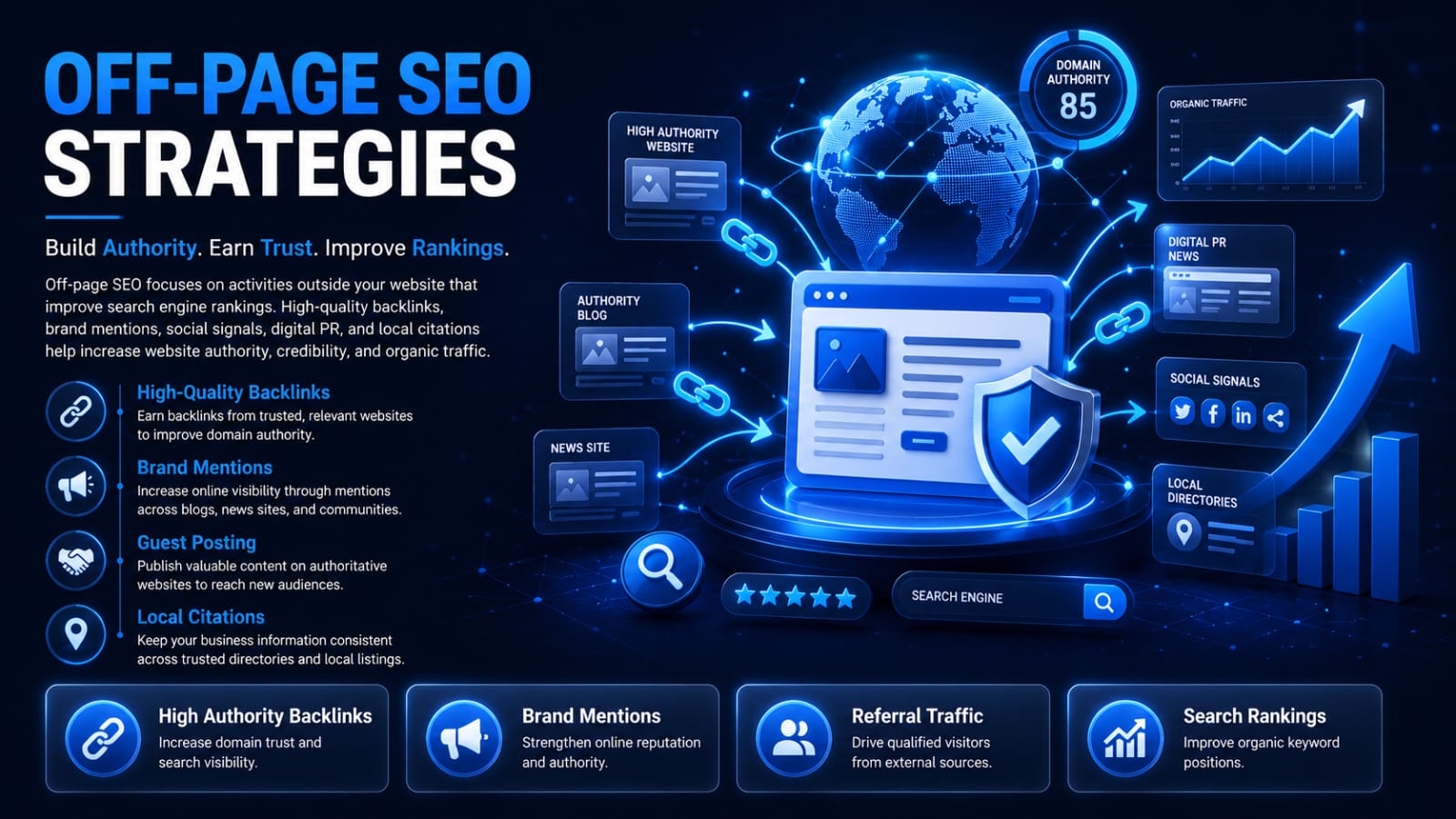
If On-Page SEO is about perfecting your own website, Off-Page SEO is about building your reputation everywhere else. It’s what tells Google — and the rest of the internet — that your website is trustworthy, authoritative, and worth ranking higher.
On-Page SEO covers elements you control directly, like content and meta tags. Off-Page SEO, on the other hand, happens outside your website: backlinks, brand mentions, social signals, and digital PR all play a role. Both work together, but off-page signals are what convince Google your site deserves long-term trust.
Without a strong off-page strategy, even the best-written content can struggle to rank against competitors with stronger authority. In this guide, you’ll learn 20 proven off-page SEO strategies that actually work in today’s search landscape, along with the tactics to avoid and how to measure your progress.
Table of Contents
- What is Off-Page SEO?
- Why Off-Page SEO Matters
- Benefits of Off-Page SEO
- Proven Off-Page SEO Strategies That Actually Work
- Off-Page SEO Techniques to Avoid
- White Hat vs Black Hat Off-Page SEO
- Best Tools for Off-Page SEO
- How to Measure Off-Page SEO Success
- Pro Tips for Long-Term SEO Success
- Off-Page SEO Checklist (Summary Table)
- Frequently Asked Questions
- Conclusion
What is Off-Page SEO?
Off-Page SEO refers to all the actions taken outside your own website that influence your search engine rankings. This includes earning backlinks from other websites, getting mentioned in the media, building a presence on social platforms, and managing your overall online reputation.
While On-Page SEO tells Google what your page is about, Off-Page SEO tells Google how trustworthy and authoritative your website is in the eyes of the wider internet.
Why Off-Page SEO Matters
Google’s algorithm relies heavily on external validation to determine which websites deserve top rankings. A page with perfect on-page optimization but zero backlinks or brand presence will almost always struggle to outrank a well-linked competitor.
Off-Page SEO builds the trust, authority, and visibility that on-page efforts alone simply can’t achieve — and it compounds over time, making it one of the most valuable long-term investments in digital marketing
Benefits of Off-Page SEO
- Higher search engine rankings for competitive keywords
- Increased domain authority and overall site credibility
- Better brand trust and recognition in your industry
- More referral traffic from high-quality external sources
- Faster indexing of new content by search engines
- Improved online visibility across search, social, and news
Proven Off-Page SEO Strategies That Actually Work
These 20 strategies form a complete, white-hat off-page SEO playbook. Focus on the ones that fit your industry and resources, and build outward from there.
1. Build High-Quality Backlinks
Backlinks from authoritative, relevant websites remain the strongest off-page ranking signal — Google treats each quality link as a vote of confidence in your content. Links from trusted domains pass authority and signal expertise. Best practice: prioritize relevance and domain authority over raw link volume. Example: a fitness blog earning one link from a well-known health publication carries more weight than ten links from random directories. Mistake: chasing quantity over quality. Tip: create genuinely link-worthy content like original research or unique data.
2. Guest Blogging
Write valuable articles for reputable websites in your niche in exchange for a backlink and exposure to a new audience. It builds authority, referral traffic, and relationships with other publishers. Best practice: pitch sites with real, engaged audiences, not link farms. Example: a SaaS company guest posting on an established marketing blog to reach potential customers. Mistake: mass-pitching low-quality or irrelevant sites. Tip: focus on 2–3 high-quality guest posts a month instead of dozens of weak ones.
3. Digital PR Campaigns
Digital PR combines traditional PR with SEO to earn coverage, mentions, and backlinks from news sites and industry publications. Media coverage brings high-authority links and brand credibility at scale. Best practice: pitch newsworthy stories, original research, or data studies to journalists. Example: releasing an industry survey that gets picked up by multiple news outlets. Mistake: pitching generic promotional content instead of real stories. Tip: build relationships with journalists before you actually need coverage.
4. Broken Link Building
Find broken (dead) links on other websites and suggest your own relevant content as a replacement. You’re helping webmasters fix a real issue while earning a natural, relevant backlink. Best practice: use tools like Ahrefs or Check My Links to find broken links in your niche. Example: finding a dead resource link on a university page and offering your updated guide instead. Mistake: suggesting irrelevant replacement content. Tip: personalize every single outreach email.
5. Brand Mentions
Not every online mention of your brand includes a link, but unlinked mentions still build authority and can often be converted into backlinks. Google increasingly treats brand mentions as a trust signal, even without a hyperlink. Best practice: monitor mentions with Google Alerts or Mention.com. Example: reaching out to a blog that mentioned your product name and asking them to add a link. Mistake: ignoring unlinked mentions entirely. Tip: always follow up politely and explain why the link would help their readers too.
6. Social Media Promotion
Sharing content on social platforms doesn’t directly boost rankings, but it increases visibility, traffic, and the chances of earning natural backlinks. More eyeballs on your content mean more opportunities for others to discover and link to it. Best practice: tailor content format to each platform. Example: turning a blog post into a LinkedIn carousel to reach a professional audience. Mistake: posting identical content everywhere without adapting it. Tip: engage with comments to extend reach further.
7. Content Marketing
Consistently publishing valuable, shareable content — blog posts, guides, videos — naturally attracts backlinks and mentions over time. Great content is the foundation that makes every other off-page tactic easier. Best practice: create “linkable assets” like original studies, templates, or free tools. Example: a free ROI calculator that other sites link to as a resource. Mistake: publishing content with no promotion plan behind it. Tip: repurpose one core piece of content into multiple formats.
8. Influencer Outreach
Partner with niche influencers to review, mention, or share your product or content with their audience. It borrows trust and reach that would otherwise take years to build organically. Best practice: choose influencers with engaged, relevant audiences over sheer follower count. Example: a skincare brand sending products to micro-influencers for honest reviews. Mistake: focusing only on follower count instead of engagement and relevance. Tip: build long-term relationships instead of one-off transactions.
9. Local SEO & Business Listings
List your business accurately across directories like Google Maps, Yelp, Justdial, and industry-specific listings to build local authority. Consistent NAP (Name, Address, Phone) data across listings builds trust with Google and local searchers. Best practice: keep your business information identical everywhere it appears. Example: a restaurant ranking in the local pack after cleaning up inconsistent listings. Mistake: duplicate or outdated listings scattered across the web. Tip: audit your listings every quarter.
10. Google Business Profile Optimization
A fully optimized Google Business Profile boosts your visibility in local search and Google Maps results. It’s one of the strongest ranking factors for local searches specifically. Best practice: add photos, respond to every review, and post updates regularly. Example: a dental clinic gaining more calls after adding service categories and fresh photos. Mistake: leaving the profile incomplete or ignoring reviews. Tip: encourage happy customers to leave detailed, keyword-rich reviews.
11. Forum Participation (Ethically)
Engage genuinely in industry forums and communities, answering questions and sharing expertise without spamming links. This builds real authority and can drive referral traffic when done naturally. Best practice: only share links when they genuinely add value to the discussion. Example: answering a technical question on a niche forum and linking to a relevant guide. Mistake: dropping links into every single reply. Tip: build a helpful reputation before promoting anything at all.
12. Q&A Platforms (Quora, Reddit, etc.)
Answer relevant questions on platforms like Quora and Reddit to build visibility and drive targeted traffic. These platforms rank extremely well on Google and put your expertise in front of active searchers. Best practice: provide genuinely useful answers, not thinly veiled ads. Example: answering an SEO question on Quora with real insights and a helpful link. Mistake: self-promotional answers that get flagged or downvoted. Tip: build a consistent presence instead of posting once and disappearing.
13. HARO / Journalist Outreach
Respond to journalist queries on platforms like HARO (Help A Reporter Out) or Qwoted to earn mentions and backlinks in news articles. Media backlinks carry exceptional authority and trust in Google’s eyes. Best practice: respond quickly with concise, quotable expert insights. Example: a financial advisor quoted in a major publication after responding to a HARO query. Mistake: sending generic, unhelpful responses. Tip: pitch specific data or a unique angle, not generic opinions.
14. Podcast Guest Appearances
Appear as a guest on industry podcasts to build authority, reach new audiences, and earn backlinks from show notes. Podcast audiences are engaged and trusting, and show notes often include a direct link to your site. Best practice: pitch podcasts where your expertise genuinely matches their audience. Example: a marketing consultant appearing on a small business podcast and gaining new leads. Mistake: pitching podcasts irrelevant to your niche. Tip: prepare a few strong talking points and a clear call-to-action.
15. Video Marketing (YouTube)
Create helpful videos on YouTube, the world’s second-largest search engine, to build visibility and earn links back to your website. Video content can rank in both YouTube and standard Google search results. Best practice: optimize titles, descriptions, and include a link in the description box. Example: a how-to video ranking on Google and driving consistent traffic for years. Mistake: ignoring video SEO basics like tags and descriptions. Tip: add closed captions to improve accessibility and rankings.
16. Infographic Marketing
Create visually engaging infographics that simplify complex information and are easy for other sites to embed and link back to. Infographics are highly shareable and often earn natural, passive backlinks. Best practice: include a ready-made embed code to make sharing effortless. Example: an infographic on industry statistics getting shared across multiple blogs. Mistake: overly complex or text-heavy designs that are hard to scan. Tip: submit infographics to dedicated infographic directories.
17. Email Outreach Campaigns
Directly email website owners, bloggers, and journalists to promote your content and request links or collaborations. Personalized outreach at scale can generate consistent, high-quality backlinks over time. Best practice: personalize each email and explain the specific value you’re offering. Example: emailing a blogger about a broken link and offering your resource as a replacement. Mistake: sending generic, mass outreach emails. Tip: follow up once, politely, if you don’t hear back within a week.
18. Community Engagement
Actively participate in industry communities — Slack groups, Discord servers, LinkedIn groups — to build relationships and organic visibility. Genuine engagement builds trust that often leads to natural mentions and links. Best practice: contribute more than you promote. Example: becoming a recognized voice in a niche Slack community and gaining referral traffic as a result. Mistake: joining communities only to self-promote. Tip: aim for a 90/10 ratio of helping versus promoting.
19. Testimonials for Other Businesses
Offer genuine testimonials for tools, software, or services you actually use, in exchange for a backlink on their website. Many companies feature customer testimonials with a link back to the author’s own site. Best practice: only review products you truly use and trust. Example: a marketing agency’s testimonial featured on a software company’s homepage with a link. Mistake: writing fake or exaggerated testimonials. Tip: reach out proactively to tools you already use and genuinely love.
20. Online Reputation Management
Monitor and manage reviews, mentions, and public perception of your brand across the web. Trust signals like reviews and star ratings influence both rankings and conversions directly. Best practice: respond to all reviews, positive and negative, professionally and promptly. Example: a business improving its star rating after actively addressing customer complaints. Mistake: ignoring negative reviews and hoping they disappear. Tip: set up alerts so you can respond to new reviews quickly.
Off-Page SEO Techniques to Avoid
These outdated or manipulative tactics violate Google’s guidelines and can lead to penalties or a complete loss of rankings:
- Buying backlinks from marketplaces or link sellers
- Using Private Blog Networks (PBNs) to manipulate rankings
- Posting spam comments with links on unrelated blogs
- Joining link farms or reciprocal link exchange schemes
- Stuffing exact-match keywords into anchor text unnaturally
- Relying on automated or bulk link-building software
- Any Black Hat technique designed to trick search engines
White Hat vs Black Hat Off-Page SEO
Understanding the difference helps you build a strategy that lasts:
|
Factor |
White Hat SEO |
Black Hat SEO |
|
Approach |
Focuses on genuine value, relevance, and user trust |
Focuses on manipulating rankings through shortcuts |
|
Link Source |
Editorial, earned, or relationship-based links |
Purchased, farmed, or automated links |
|
Risk Level |
Low — builds sustainable, long-term rankings |
High — can trigger Google penalties or de-indexing |
|
Longevity |
Compounding results that grow stronger over time |
Short-term gains that often collapse after an algorithm update |
|
Examples |
Guest posts, digital PR, HARO, quality content |
PBNs, bought links, spam comments, link farms |
Best Tools for Off-Page SEO
These tools make backlink research, outreach, and monitoring far more efficient:
|
Tool |
What It’s Best For |
|
Google Search Console |
Monitor backlinks, indexing, and search performance for free |
|
Ahrefs |
Backlink analysis, competitor research, and content gap analysis |
|
SEMrush |
Backlink audits, outreach tracking, and brand mention monitoring |
|
Moz |
Domain Authority tracking and link building opportunities |
|
Majestic SEO |
Trust Flow and Citation Flow metrics for link quality |
|
BuzzSumo |
Find trending content and influencers to reach out to |
|
Hunter.io |
Find verified email addresses for outreach campaigns |
|
Google Alerts |
Track brand mentions across the web in real time |
How to Measure Off-Page SEO Success
Track these key metrics to understand whether your off-page strategy is actually working:
|
Metric |
What It Tells You |
|
Domain Authority (DA) |
Moz’s score predicting how well a site can rank, from 1–100 |
|
Domain Rating (DR) |
Ahrefs’ equivalent metric measuring backlink profile strength |
|
Backlink Quality |
Relevance, authority, and trustworthiness of linking sites |
|
Referring Domains |
The number of unique websites linking to you |
|
Organic Traffic |
Visitors arriving through unpaid search results |
|
Referral Traffic |
Visitors arriving through backlinks on other websites |
|
Keyword Rankings |
Your position in search results for target keywords |
|
Brand Mentions |
How often your brand is mentioned across the web, linked or not |
Pro Tips for Long-Term SEO Success
- Focus on earning links naturally through great content rather than chasing shortcuts
- Diversify your backlink profile across different domains and link types
- Track competitor backlinks to uncover new outreach opportunities
- Prioritize relevance over Domain Authority when evaluating a potential link
- Combine multiple off-page tactics instead of relying on just one channel
- Stay consistent — off-page SEO compounds over months, not days
Off-Page SEO Checklist (Summary Table)
Use this quick-reference table to plan and track your off-page SEO efforts:
|
# |
Strategy |
Done? |
|
1 |
Build High-Quality Backlinks |
☐ |
|
2 |
Guest Blogging |
☐ |
|
3 |
Digital PR Campaigns |
☐ |
|
4 |
Broken Link Building |
☐ |
|
5 |
Brand Mentions |
☐ |
|
6 |
Social Media Promotion |
☐ |
|
7 |
Content Marketing |
☐ |
|
8 |
Influencer Outreach |
☐ |
|
9 |
Local SEO & Business Listings |
☐ |
|
10 |
Google Business Profile Optimization |
☐ |
|
11 |
Forum Participation (Ethically) |
☐ |
|
12 |
Q&A Platforms (Quora, Reddit, etc.) |
☐ |
|
13 |
HARO / Journalist Outreach |
☐ |
|
14 |
Podcast Guest Appearances |
☐ |
|
15 |
Video Marketing (YouTube) |
☐ |
|
16 |
Infographic Marketing |
☐ |
|
17 |
Email Outreach Campaigns |
☐ |
|
18 |
Community Engagement |
☐ |
|
19 |
Testimonials for Other Businesses |
☐ |
|
20 |
Online Reputation Management |
☐ |
Frequently Asked Questions
What is Off-Page SEO in simple words?
Off-Page SEO refers to all the actions taken outside your own website — like earning backlinks, brand mentions, and social signals — that help improve your search engine rankings and authority.
How is Off-Page SEO different from On-Page SEO?
On-Page SEO covers what you control directly on your website, like content and meta tags. Off-Page SEO covers external factors like backlinks, PR, and brand reputation built on other platforms.
How long does Off-Page SEO take to show results?
Off-Page SEO is a long-term strategy. Most websites start seeing measurable improvements in domain authority and rankings within 3 to 6 months of consistent effort.
Are backlinks still important for SEO in 2026?
Yes. Backlinks remain one of Google’s top three ranking factors, though quality and relevance now matter far more than sheer quantity.
Is guest blogging still an effective strategy?
Yes, when done correctly. Guest blogging on relevant, reputable sites still builds authority and referral traffic, but mass, low-quality guest posting can actually hurt your rankings.
Can buying backlinks get my site penalized?
Yes. Buying links violates Google’s Webmaster Guidelines and can lead to manual penalties or a significant drop in rankings if detected.
What is Domain Authority, and why does it matter?
Domain Authority is a third-party metric (created by Moz) that predicts how likely a website is to rank in search results. Higher authority generally correlates with stronger backlink profiles.
Do social media signals directly affect Google rankings?
Not directly, but social media increases content visibility, which leads to more natural backlinks and brand mentions — both of which do influence rankings.
What is the safest Off-Page SEO strategy for beginners?
Content marketing combined with genuine outreach — like guest posting and broken link building — is one of the safest, most sustainable starting points for beginners.
How many backlinks do I need to rank higher?
There’s no fixed number. Quality, relevance, and diversity of linking domains matter far more than the total count of backlinks.
What is Digital PR, and is it worth the investment?
Digital PR involves earning media coverage and backlinks through newsworthy stories and data. It’s highly effective for building authority quickly, though it typically requires a bigger investment than basic link building.
Can I do Off-Page SEO myself, or do I need an agency?
Small businesses can start with basics like Google Business Profile optimization and local listings. For competitive industries, an experienced agency like DIGIDIKSHA can accelerate results through proven relationships and outreach systems.
Conclusion
Off-Page SEO is not a one-time task — it’s an ongoing process of building trust, authority, and visibility across the web. The strategies that actually work all share the same foundation: genuine value, relevance, and consistency over shortcuts.
Start with two or three strategies that fit your business best, execute them consistently, and expand from there as you see results. Over time, these efforts compound into stronger rankings, more referral traffic, and lasting brand authority.
Ready to Build Real Authority? Let DIGIDIKSHA Help
Executing an effective off-page SEO strategy takes time, industry relationships, and the right outreach systems. DIGIDIKSHA’s SEO specialists can audit your current backlink profile, identify new opportunities, and build a customized off-page strategy that earns real, lasting authority.
Contact DIGIDIKSHA today for a free SEO consultation, backlink audit, and customized off-page SEO strategy — and start building the authority your website deserves.
