
Introduction
In a world overflowing with social media noise and paid ads, email marketing remains one of the most powerful, direct, and cost-effective channels available to businesses of any size. With an average return of $36 for every $1 spent, it consistently outperforms every other digital marketing channel on ROI — and in 2026, that is truer than ever.
For small businesses, startups, and e-commerce brands, email marketing is not just about sending newsletters. When done right, it is a precision tool for building long-term customer relationships, driving repeat purchases, nurturing leads, and increasing sales without relying on expensive paid advertising.
In this guide, you will discover the top 10 email marketing best practices that actually move the needle, the most common mistakes to avoid, the trends shaping the industry in 2026, and the best tools to get started. Whether you are brand new to email marketing or ready to take your campaigns to the next level, this guide is built for you.
What is Email Marketing?
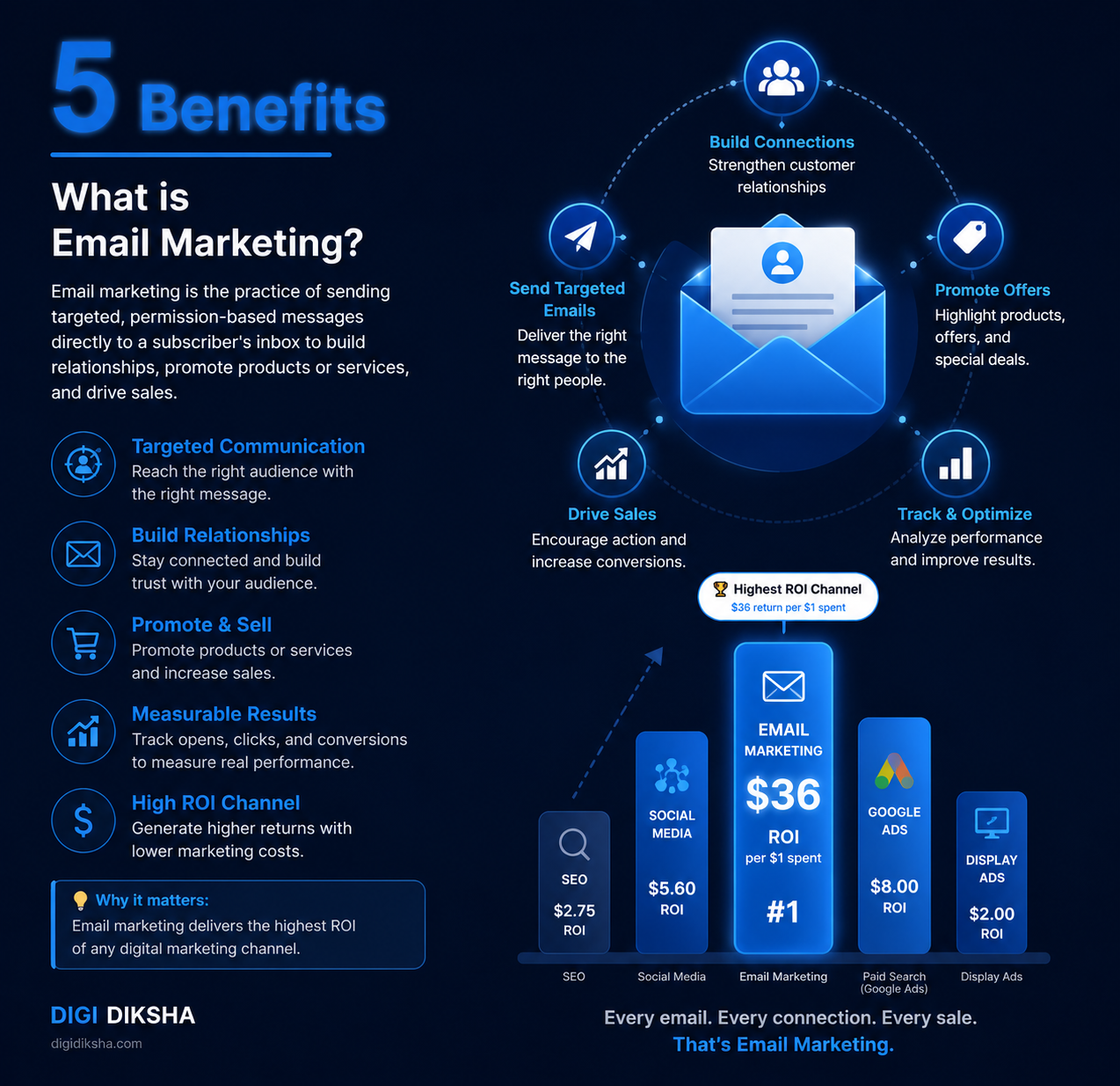
Unlike social media posts that compete with thousands of other pieces of content in an algorithm-controlled feed, emails land directly in front of the recipient — on their terms. That direct, personal line of communication makes email one of the most powerful relationship-building tools in digital marketing.
At its best, email marketing is not about blasting promotions at a cold list. It is about delivering the right message, to the right person, at exactly the right time — and doing that consistently is what builds the kind of customer loyalty that drives sustainable revenue growth.
Why Email Marketing is Important for Increasing Sales
Here is why investing in a strong email marketing strategy pays off directly at the bottom line:-
• High ROI: Email marketing delivers an average of $36 return for every $1 invested — the highest ROI of any marketing channel available.• Direct customer communication: Your message goes straight to the inbox, bypassing algorithms and competitive noise entirely.
• Personalized marketing: Emails can be tailored to individual preferences, behavior, and purchase history at scale.
• Customer retention: Regular, valuable communication keeps your brand top-of-mind between purchases, reducing churn.
• Lead nurturing: Automated sequences guide potential customers from initial interest through to their first purchase.
• Brand trust: Consistent, helpful emails position your business as a credible, expert resource in your field.
• Increased website traffic: Every email is an opportunity to drive clicks back to your site, product pages, or blog.
• Repeat purchases: Targeted post-purchase and loyalty emails generate significantly more revenue from existing customers.
Example: An e-commerce clothing brand sends a personalized restock alert to customers who previously viewed a sold-out item. That single automated email generates a 28% conversion rate — outperforming any paid ad campaign in the same period.
Top 10 Email Marketing Best Practices to Increase Sales
1. Build a Quality Email List
The foundation of every successful email campaign is a clean, permission-based list of people who genuinely want to hear from you. Never purchase email lists — they damage your sender reputation, drive spam complaints, and deliver zero real ROI.Instead, build your list organically with these proven methods:
• Offer valuable lead magnets (free guides, templates, discount codes, or checklists) in exchange for an email address
• Add newsletter signup forms to your website's homepage, blog posts, and checkout page
• Use exit-intent popups that trigger when a visitor is about to leave your site• Run social media campaigns that drive followers to a dedicated email signup landing page
2. Segment Your Audience
Sending the same email to your entire list is one of the fastest ways to drive up unsubscribes. Audience segmentation — dividing your list into targeted groups — allows you to send highly relevant messages that resonate and convert.Segment your list based on:
• Purchase history (what they bought and when)
• Browsing or engagement behavior (what pages they visited, what emails they clicked)
• Demographics (age, location, job role)
• Stage in the customer journey (new lead, active customer, lapsed buyer)Segmented campaigns generate 14% higher open rates and 101% higher click rates than non-segmented campaigns, according to Mailchimp research.
3. Write Compelling Subject Lines
Your subject line is the single most important factor determining whether your email gets opened or ignored. With the average person receiving 120+ emails per day, you have roughly 3 seconds to earn their attention.Examples of high-performing subject lines:
• "Your exclusive discount expires in 24 hours "
• "We noticed you left something behind..."
• "[First Name], here are 5 things you're missing"
• "Only 3 left in stock — don't miss out"Best practices: keep subject lines under 50 characters, use numbers, create genuine urgency, ask questions, and A/B test every variation you can.
4. Personalize Every Email
Personalization goes far beyond inserting someone's first name into a greeting. Modern email personalization uses behavioral and preference data to make every message feel like it was written specifically for that individual
.• Address subscribers by their first name throughout the email, not just in the subject line
• Recommend products based on their previous purchases or browse history• Use dynamic content blocks that display different content based on subscriber segments
• Send birthday and anniversary emails with a special reward attachedEmails with personalized subject lines generate 26% higher open rates, and personalized CTAs convert 202% better than generic ones.
5. Create Valuable Content
Not every email should be a sales pitch. The most effective email marketing programs balance promotional content with genuinely useful information that subscribers look forward to receiving.
• Educational emails: Industry tips, how-to guides, tutorials — position your brand as the expert.
• Promotional emails: Sales, discounts, new arrivals — drive immediate conversions.
• Product recommendations: Based on past behavior, suggest items the subscriber is most likely to buy next.
• Seasonal campaigns: Holiday sales, back-to-school offers, end-of-year deals — tap into buying momentum.A good rule of thumb: follow an 80/20 approach — 80% value-driven content, 20% direct promotion.
6. Optimize for Mobile Devices
Over 60% of emails are now opened on a mobile device, making responsive email design non-negotiable. An email that looks great on desktop but breaks on a smartphone will cost you opens, clicks, and trust.Mobile-friendly email best practices:
• Use a single-column layout that stacks cleanly on small screens
• Keep font sizes at a minimum of 14px for body text, 22px for headlines
• Make CTA buttons at least 44px tall so they are easy to tap with a thumb
• Compress images to keep load times fast on mobile data connections
• Test every email on both iOS and Android before sending
7. Use Clear Call-to-Actions (CTAs)
Every email you send should have one clear, prominent call-to-action that tells the reader exactly what to do next. Multiple competing CTAs dilute focus and lower conversion rates.Examples of effective CTA button copy:
• Shop Now — for promotional emails
• Get Started Today — for service or trial sign-ups
• Download Your Free Guide — for lead magnet delivery
• Claim Your Discount — for time-sensitive offers
• Read the Full Article — for content-driven emailsUse contrasting button colors, keep the copy action-oriented and benefit-led, and place the CTA above the fold whenever possible.
8. Automate Email Campaigns
Email automation lets you deliver the right message at the exact right moment — without manually sending every email. Automated workflows run in the background, nurturing leads and driving revenue 24/7.Essential automation workflows every business should set up:
• Welcome series: Greet new subscribers, introduce your brand, and deliver any promised lead magnet.
• Abandoned cart emails: Remind shoppers about items they left behind — these recover 5–15% of abandoned carts on average.
• Birthday and anniversary emails: Personal milestone emails with a special offer drive high open and conversion rates.
• Post-purchase follow-ups: Thank customers, request reviews, and suggest complementary products.
• Re-engagement campaigns: Win back inactive subscribers before they go cold permanently.
9. Test and Optimize Your Campaigns
The difference between average email marketers and great ones is a commitment to continuous testing and improvement. A/B testing allows you to compare two versions of an email element to find out which performs better with your specific audience.Elements to A/B test regularly:
• Subject lines — even small wording changes can shift open rates dramatically
• CTA button copy, color, and placement
• Hero images versus text-only layouts
• Email copy length and tone (formal versus conversational)
• Send day and time (Tuesday mornings versus Thursday afternoons, for example)Test one variable at a time so you know exactly which change drove the result, then apply winners to future campaigns.raph here
10. Track Performance Metrics
You cannot improve what you do not measure. Tracking the right KPIs after every campaign tells you precisely what is working and where to focus your optimization efforts.

Review these metrics after every campaign send, identify patterns over time, and set realistic improvement targets for each metric based on your industry benchmarks
Common Email Marketing Mistakes to Avoid
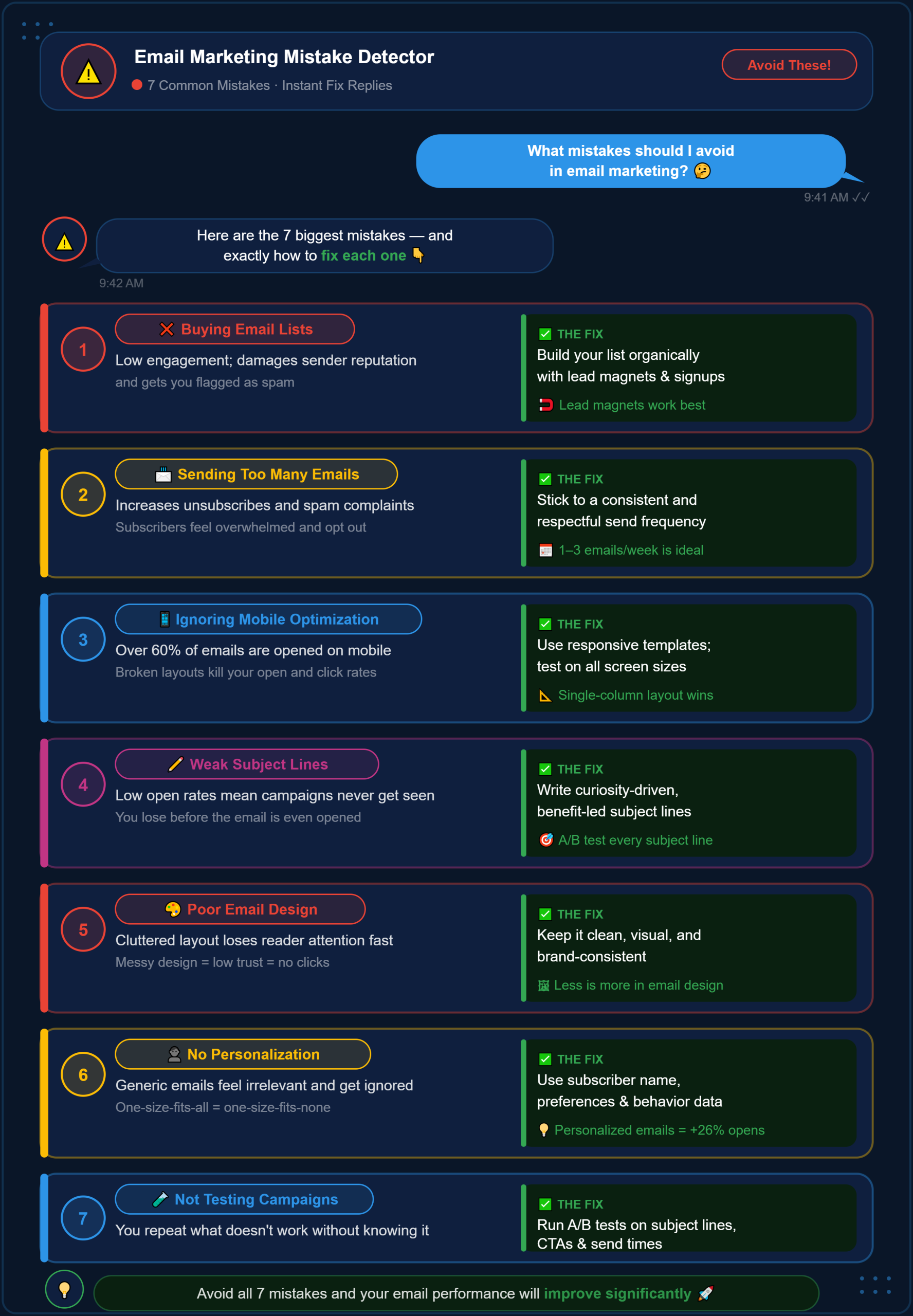
Even experienced marketers fall into these traps. Here is a clear summary of the most costly email marketing mistakes and exactly how to fix them:
Latest Email Marketing Trends in 2026
The email marketing landscape is evolving fast. Here are the eight trends shaping the industry right now that forward-thinking marketers are already adopting:
• AI-powered email personalization: AI tools now analyze subscriber behavior in real time and automatically adjust content, timing, and product recommendations for each individual — dramatically improving conversion rates.
• Interactive emails: Embed quizzes, image carousels, polls, and even checkout directly inside the email, so subscribers can take action without leaving their inbox.
• Predictive automation: Machine learning models predict when each individual subscriber is most likely to make their next purchase and trigger the right email at that exact moment.
• Privacy-first marketing: With stricter data regulations and the decline of third- party cookies, building a strong first-party email list has become one of the most valuable marketing assets a business can own.
• Hyper-personalization: Goes beyond using a subscriber's name to tailoring every element of the email — imagery, copy, offers, and layout — to their specific preferences and history.
• AMP emails: Accelerated Mobile Pages technology allows subscribers to complete forms, browse products, and take actions directly inside the email without visiting a separate web page.
• Behavioral triggers: Automated emails fired by specific subscriber actions (browsing a product page, watching a video, reaching a loyalty milestone) outperform batch-and-blast sends by 5–10x.
• Zero-party data collection: Proactively asking subscribers for their preferences, goals, and interests through surveys and preference centers builds richer personalization data without privacy concerns.
Best Email Marketing Tools for 2026
Choosing the right platform makes every strategy easier to execute. Here is a comparison of the top email marketing tools to help you find the best fit:

• Mailchimp is ideal for beginners who want an easy-to-use platform with solid automation and a generous free tier to get started.
• Brevo (formerly Sendinblue) is a great value option for small businesses that also want SMS marketing and transactional email capability alongside their campaigns.
• ConvertKit is the top choice for content creators, bloggers, and course sellers who need powerful visual automation with subscriber tagging
.• HubSpot suits businesses that want email marketing tightly integrated with a full CRM and sales pipeline, with detailed contact-level reporting.
• Klaviyo is the industry standard for e-commerce brands, especially those on Shopify, offering the deepest product data integration and predictive analytics available.
Conclusion
Implementing these email marketing best practices is one of the highest-return investments your business can make in 2026. From building a quality permission-based list and segmenting your audience, to writing irresistible subject lines, leveraging automation, and tracking the metrics that matter — every step in this guide is designed to help you turn email into a reliable, scalable sales channel.
The businesses that win with email are not the ones who send the most emails. They are the ones who send the right emails, to the right people, at exactly the right time — consistently, and with genuine value in every message.
Start with two or three of these practices today. Master them, measure the results, and build from there. Email marketing rewards patience and consistency above everything else.
