
Introduction
Every business owner asks the same question at some point: how do you get more people to visit your website without spending a fortune on ads? The answer, for most brands that succeed online in 2026, is content marketing. Content marketing is the practice of creating and sharing valuable, relevant material such as blog posts, videos, guides, and infographics to attract, engage, and retain a clearly defined audience.
Quality content matters more than ever this year because search engines, especially Google, now reward genuinely helpful information over thin, keyword-stuffed pages. With AI Overviews reshaping search results and audiences growing more selective about what they read, brands that publish consistent, trustworthy content win the long game. Content marketing strategies that increase website traffic don't rely on quick tricks; they compound over months and years, turning a handful of well-optimized articles into a steady stream of visitors, leads, and customers.
In this guide, you'll learn what content marketing really means, why it drives sustainable traffic growth, the top 15 content marketing strategies that increase website traffic, common mistakes to avoid, the latest trends shaping the industry, and the tools professionals use to get results.
What is Content Marketing?
Content marketing is a strategic approach to creating and distributing valuable, relevant, and consistent content to attract and retain a clearly defined audience, ultimately driving profitable customer action. Unlike traditional advertising, which interrupts people with a sales pitch, content marketing earns attention by solving problems and answering questions first.
This distinction matters because audiences today are skeptical of overt advertising but receptive to brands that genuinely help them. A billboard or a paid banner asks for attention; a well-written how-to guide or an in-depth comparison article gives value before asking for anything in return. That single shift, from interrupting to informing, is what allows content marketing to build lasting trust and authority.
Over time, a business that consistently publishes helpful content becomes the go-to resource in its niche. When readers repeatedly find useful answers on your website, they begin to trust your brand's expertise, and that trust naturally extends to your products and services.
A Practical Example
Imagine two competing accounting software companies. Company A only runs paid ads promoting its features. Company B publishes weekly blog posts on topics like "How Small Businesses Can Simplify Tax Filing" and "Common Bookkeeping Mistakes to Avoid." Over a year, Company B's articles start ranking on Google for dozens of relevant searches, bringing in thousands of free visitors every month, many of whom convert into paying customers because they already trust the brand's expertise. Company A keeps paying for every single click. This is the compounding advantage of content marketing.
Why Content Marketing is Important for Website Traffic
Content marketing isn't just a nice-to-have; it's one of the most cost-effective ways to grow website traffic sustainably. Here's why it matters so much for driving visitors to your site.
• Improves organic search rankings by consistently targeting keywords your audience is searching for
• Increases website visitors as more pages become discoverable through search engines
• Builds brand awareness by putting your name in front of people at every stage of their research
• Generates qualified leads by attracting people who are actively looking for solutions you offer
• Improves customer trust because helpful, accurate content signals genuine expertise
• Supports broader SEO efforts by creating natural opportunities for internal linking and keyword coverage
• Encourages social sharing, which extends your reach beyond your existing audience
• Delivers long-term ROI, since a single well-optimized article can attract traffic for years
Consider HubSpot, a company that built much of its early growth on free blog content and downloadable guides rather than paid advertising alone. By answering the exact questions its target audience was typing into Google, it turned its blog into one of the biggest traffic-generating assets of the entire business, a pattern now replicated by countless companies across industries.
Top 15 Content Marketing Strategies That Increase Website Traffic
Below are the 15 most effective content marketing strategies for driving consistent, long-term traffic growth.
1. Understand Your Target Audience
Every successful content strategy starts with a clear picture of who you're writing for. Audience research involves studying demographics, pain points, goals, and online behavior so you can create content that genuinely resonates.Building detailed buyer personas, fictional profiles representing your ideal customers, helps you make consistent decisions about topics, tone, and format. Just as important is understanding search intent: are readers looking to learn something, compare options, or make a purchase? Matching your content to that intent is what separates articles that rank from articles that don't.
2. Perform Keyword Research
Keyword research is the foundation of any content marketing strategy that increases website traffic. Short-tail keywords (like "content marketing") are broad and highly competitive, while long-tail keywords (like "content marketing strategies for small businesses") are more specific and easier to rank for.
Understanding search intent, whether a searcher wants information, a comparison, or to make a purchase, ensures your content matches what people actually want. Keyword clustering, grouping related keywords under one comprehensive piece of content, helps you rank for dozens of variations with a single article. Tools like Google Keyword Planner and Ahrefs make it easy to uncover search volume, difficulty, and related terms.
3. Create High-Quality, Helpful Content
Google's guidelines increasingly reward original, people-first content. This means your writing should reflect real experience, expertise, authoritativeness, and trustworthiness, commonly known as EEAT.
Rather than rehashing what's already ranking, aim to add a unique perspective, original research, or practical examples. The goal is always to solve a genuine problem or answer a real question your audience is asking, not simply to hit a word count.
4. Publish SEO-Optimized Blog Posts
On-page SEO turns good content into discoverable content. This includes optimizing your title tag to include your primary keyword naturally, structuring headings (H1, H2, H3) logically, and writing meta descriptions that encourage clicks from the search results page.
Internal linking connects your new content to related articles on your site, helping both readers and search engines navigate your website more effectively. Don't forget image optimization: compressed file sizes and descriptive alt text improve both page speed and accessibility.
5. Focus on Evergreen Content
Evergreen content covers topics that remain relevant regardless of when someone reads them, think "how-to" guides, definitions, and foundational tutorials. Unlike trend-based posts that spike and fade, evergreen articles continue attracting search traffic month after month, making them some of the highest-ROI assets in your content library.
6. Update Existing Content Regularly
Search engines favor fresh, accurate information. Periodically revisiting older articles to update statistics, replace outdated examples, and refine keyword targeting can restore or even boost rankings for content that has started to slip, often with far less effort than creating something new from scratch.
7. Create Topic Clusters
A topic cluster strategy organizes your content around a central "pillar" page covering a broad subject, supported by multiple "cluster" articles that explore specific subtopics in depth. For example, a pillar page on "Digital Marketing" might link out to cluster posts on SEO, email marketing, and social media strategy.
This structure signals topical authority to search engines and makes it easier for readers to explore related content, both of which contribute to stronger rankings and longer site visits.
8. Use Visual Content
Visuals like infographics, custom images, charts, and videos break up dense text and make complex ideas easier to digest. Well-designed visuals also increase the time visitors spend on a page and make content more shareable on social media, both of which send positive engagement signals to search engines.
9. Optimize for Featured Snippets
Featured snippets, the highlighted answer boxes that appear above regular search results, drive significant traffic to the sites that earn them. Structuring content with question-based headings, concise definitions, numbered lists, and comparison tables increases your odds of being selected as the answer Google displays.
10. Promote Content on Social Media
Publishing great content isn't enough if no one sees it. Sharing articles across Facebook, Instagram, LinkedIn, X (formerly Twitter), and Pinterest extends your reach to audiences who may never find you through search alone, and social shares often lead to backlinks and referral traffic over time.
11. Build High-Quality Backlinks
Backlinks from reputable websites remain one of the strongest ranking signals in SEO. Ethical link-building strategies include guest posting on relevant industry sites, earning links through original research or data studies, and building relationships with journalists and bloggers in your niche. Quality always matters more than quantity here.
12. Use Email Marketing
Email remains one of the most reliable ways to drive repeat website traffic. Newsletters that highlight your latest articles keep your audience engaged and give them a reason to return to your site regularly, rather than relying solely on new visitors from search or social media.
13. Repurpose Content
A single well-researched blog post can be transformed into a short video, a series of social media reels, an infographic, a carousel post, or even a podcast episode. Repurposing multiplies the return on the time you invest in creating content and helps you reach audiences on the platforms they prefer.
14. Analyze Content Performance
You can't improve what you don't measure. Tracking metrics like organic traffic, bounce rate, average session duration, conversion rate, and keyword rankings tells you what's working and what needs revision.
Google Analytics 4 provides detailed behavioral insights, while Google Search Console shows exactly which queries bring visitors to your site, information that's invaluable for refining your content strategy over time.
15. Create a Consistent Publishing Schedule
Consistency signals to both search engines and readers that your website is active and reliable. A predictable publishing schedule, whether that's weekly, biweekly, or monthly, helps you build momentum, keeps your audience engaged, and steadily grows your library of content assets over time.
Common Content Marketing Mistakes to Avoid
Even well-intentioned content strategies can fall short. Here are the most common mistakes brands make, along with how to fix them
.Publishing low-quality content:
Prioritize depth and accuracy over volume; every article should genuinely help the reader.
Ignoring SEO:
Pair great writing with on-page optimization so your content can actually be found.
Not understanding user intent:
Research what searchers truly want before choosing a content format or angle.
Inconsistent posting:
Set a realistic publishing calendar and stick to it, even if it means posting less often.
Duplicate content:
Ensure every page offers unique value and avoid repurposing without meaningful changes.
Weak headlines:
Craft clear, benefit-driven titles that make the click worthwhile.
Lack of internal linking:
Connect related articles so readers and search engines can navigate your site easily.
Ignoring analytics:
Review performance data regularly and adjust your strategy based on real resultsEven well-intentioned content strategies can fall short. Here are the most common mistakes brands make, along with how to fix them.
Latest Content Marketing Trends (2026)
Staying current with emerging trends helps your content strategy stay competitive. Here's what's shaping content marketing this year.
• AI-assisted content creation, using AI tools to speed up research, outlining, and drafting while keeping human judgment in the loop
• Optimizing for Google's AI Overviews, structuring content so it can be clearly summarized and cited
• Voice search optimization, writing in natural, conversational language that how people speak to voice assistants
• Interactive content, such as quizzes, calculators, and polls that boost engagement and time on page
• Personalized content experiences tailored to a visitor's behavior, location, or stage in the buyer journey
• A continued video-first strategy, with short-form video becoming a primary discovery channel
• User-generated content, leveraging reviews, testimonials, and community contributions for authenticity
• Content experience optimization, improving page speed, readability, and mobile design alongside the writing itself
Best Content Marketing Tools
The right tools make it easier to plan, create, optimize, and measure your content. Here's a quick comparison of some of the most popular options.
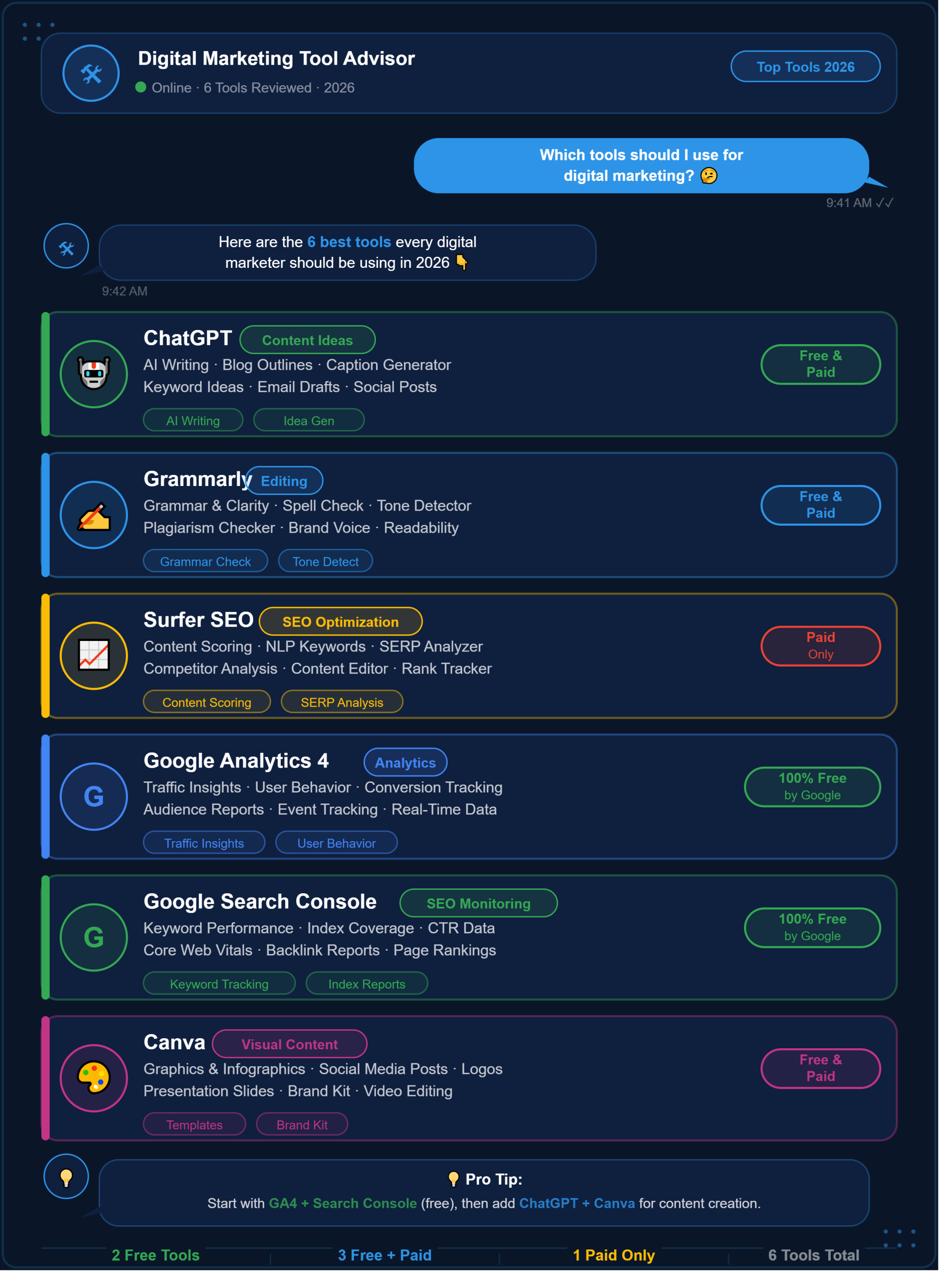
ChatGPT helps content marketers brainstorm topic ideas, outline articles, and overcome writer's block faster, though human editing and fact-checking remain essential.
Grammarly catches grammar, spelling, and clarity issues in real time, helping ensure every published piece reads smoothly and professionally.
Surfer SEO analyzes top-ranking pages for a given keyword and scores your draft against them, guiding on-page optimization decisions.
Google Analytics 4 reveals how visitors behave on your site, which pages perform best, and where they drop off, informing future content decisions.
Google Search Console shows exactly which search queries drive traffic to your pages, making it easier to spot new keyword opportunities.
Canva simplifies the creation of infographics, social graphics, and blog images, even for teams without a dedicated design resource.
Frequently Asked Questions (FAQs)
What is content marketing and how does it work?
Content marketing is the practice of creating and distributing valuable, relevant content to attract and engage a specific audience. It works by answering the questions your audience is already searching for, building trust that eventually leads to conversions.
How does content marketing increase website traffic?
Content marketing increases website traffic by helping pages rank in search results, giving people a reason to share your content on social media, and encouraging repeat visits through email and other channels.
How long should a blog post be for good SEO?
There's no universal ideal length; the right length depends on what fully answers the searcher's question. That said, in-depth guides covering a topic comprehensively, often 1,500 words or more, tend to perform well for competitive keywords.
How important is keyword research for content marketing?
Keyword research is essential because it reveals exactly what your audience is searching for, ensuring you invest time in topics with real demand rather than guessing what might resonate.
Can small businesses benefit from content marketing?
Yes. Content marketing is often more cost-effective than paid advertising for small businesses, since well-optimized articles can continue attracting visitors for years without ongoing ad spend.
Conclusion
\Content marketing strategies that increase website traffic aren't built overnight, but the compounding results are worth the investment. From understanding your audience and mastering keyword research to creating topic clusters, optimizing for featured snippets, and analyzing performance data, each strategy in this guide plays a role in building a steady, sustainable stream of visitors to your website.
The businesses that win in 2026 and beyond will be the ones that commit to publishing genuinely helpful, well-optimized content consistently, rather than chasing short-term traffic spikes. Start with one or two strategies from this guide, measure your results, and expand from there.
If you're ready to put these content marketing strategies into action but don't have the time or in-house expertise to execute them consistently, DIGIDIKSHA can help. Our team specializes in professional content marketing services designed to drive measurable website traffic and real business growth. Contact DIGIDIKSHA today to build a content strategy that turns your website into your most valuable marketing asset.
