Social Media Marketing

Social Media Marketing

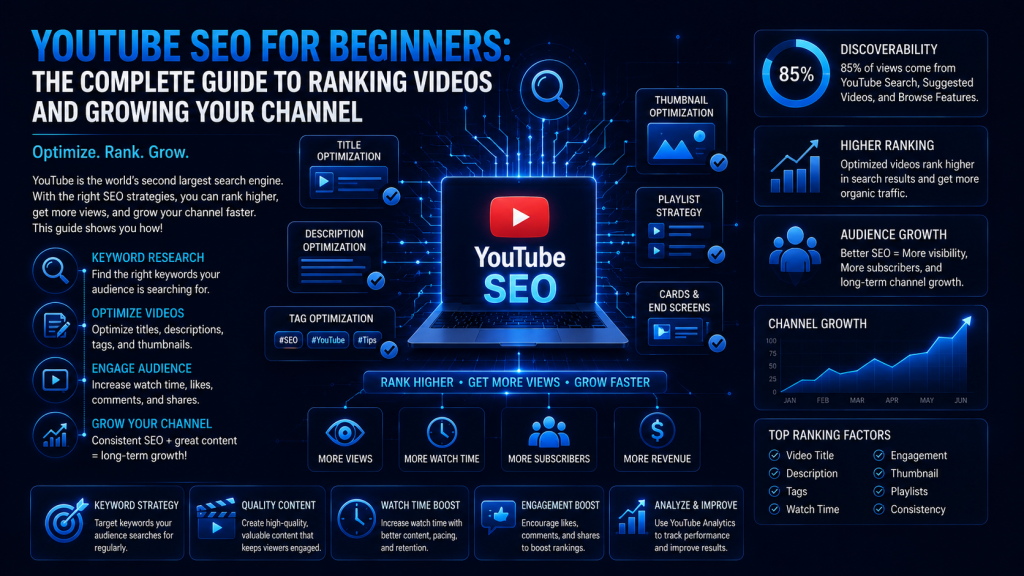
YouTube SEO for Beginners: The Complete Guide to Ranking Videos and Growing Your Channel

Introduction YouTube is the world’s second-largest search engine, and getting your videos to rank means real, lasting traffic instead of a one-time spike. This guide breaks down exactly how YouTube SEO works and gives you a practical, beginner-friendly path to grow your channel. What Is YouTube SEO? YouTube SEO is the process of optimizing your videos, titles, descriptions, and channel so they appear in YouTube search and suggested results. Unlike Google SEO, YouTube ranking depends heavily on watch time and viewer satisfaction, not just keywords. How the YouTube Algorithm Works YouTube ranks videos based on watch time, audience retention, click-through rate, and overall session time. The algorithm favors videos that keep viewers watching YouTube longer, so retention and engagement matter as much as keywords. Benefits of YouTube SEO More organic views and subscriber growth Higher engagement and watch time Stronger brand awareness and authority More website traffic and leads Long-term, compounding organic growth Step-by-Step YouTube SEO Guide for Beginners Choose a focused, specific niche Do keyword research before filming Match your content to search intent Create high-quality, valuable videos Write optimized, keyword-rich titles Craft detailed, SEO-friendly descriptions Add relevant tags and hashtags Design clickable, high-contrast thumbnails Add timestamps, captions, and end screens Organize videos into playlists Upload consistently and review analytics regularly YouTube Keyword Research Start with YouTube’s own search suggest feature to find real queries viewers type in. Tools like TubeBuddy, vidIQ, Google Trends, and Ahrefs help you validate search volume, competition, and long-tail keyword opportunities. Optimizing Every Part of a Video Every element matters: an SEO-friendly title and file name, a keyword-rich description, accurate tags, a compelling thumbnail, captions, chapters, and a pinned comment that encourages engagement all work together to boost rankings. YouTube Shorts SEO Shorts rank differently, relying heavily on strong hooks in the first few seconds, relevant hashtags, and concise, keyword-aware titles. Consistent posting and high completion rates drive Shorts discovery. Common YouTube SEO Mistakes Keyword stuffing titles and descriptions Using misleading or clickbait thumbnails Writing weak, vague titles Leaving descriptions empty or generic Uploading inconsistently Ignoring YouTube Analytics Skipping playlists and end screens Best Practices for YouTube SEO Post on a consistent, predictable schedule Focus on retention with strong hooks and pacing Design thumbnails that stand out in search Optimize metadata for every upload Reply to comments to boost engagement Use playlists to increase session time Collaborate with other creators in your niche Review analytics weekly and adjust strategy Measuring YouTube SEO Success Views and watch time Average view duration and audience retention Click-through rate (CTR) Subscriber growth and engagement rate Traffic sources and conversion rate Latest YouTube SEO Trends AI-powered video recommendations Rapid growth of YouTube Shorts Voice search optimization AI-generated captions and multi-language content Community posts and live streaming SEO Frequently Asked Questions 1.Can small channels rank on YouTube? Yes. Niche-focused, well-optimized videos with strong retention can outrank larger channels for specific search terms. 2.How many tags should I use? Focus on a handful of relevant, specific tags rather than maxing out the character limit with unrelated keywords. 3.How long does YouTube SEO take to show results? Most channels see meaningful traction within three to six months of consistent, optimized uploads. Conclusion YouTube SEO is a long-term growth strategy built on quality content, smart keyword use, and strong viewer retention. Apply these steps consistently, review your analytics, and refine your approach to build sustainable channel growth. Grow Your Channel With DIGIDIKSHA DIGIDIKSHA offers expert YouTube SEO, video marketing, content marketing, and complete digital marketing solutions to help your channel rank higher and reach the right audience. Contact us today for a free consultation and start growing your YouTube presence with professional guidance.
Social Media Marketing

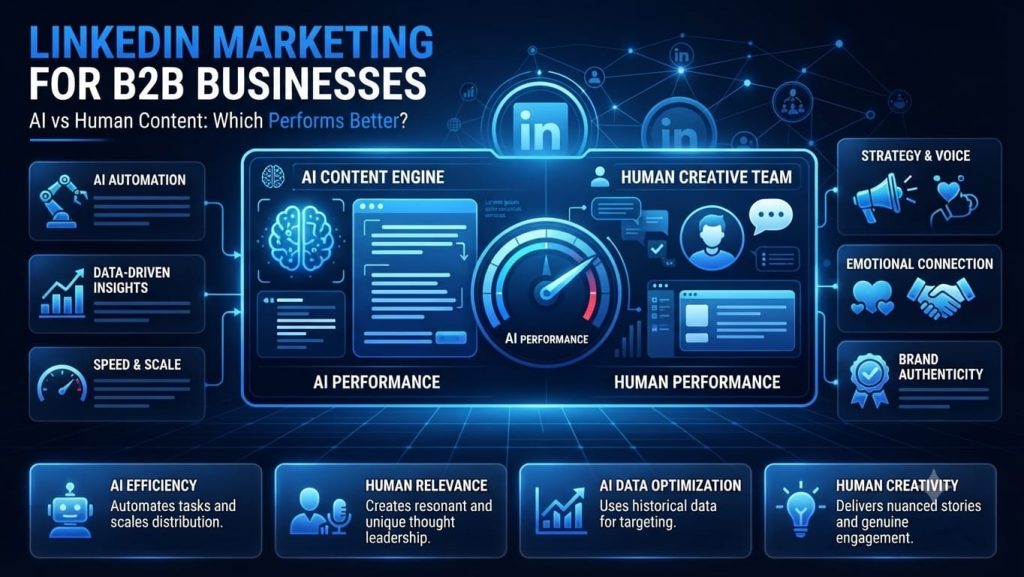
LinkedIn Marketing for B2B Businesses

Introduction LinkedIn has grown into the most trusted platform for B2B marketing. Unlike consumer-first networks, it connects businesses directly with decision-makers, founders, and buyers who are actively looking for solutions. This guide walks you through everything you need to know to build a winning LinkedIn marketing strategy, generate high-quality leads, and grow your brand’s authority in your industry. What Is LinkedIn Marketing? LinkedIn marketing means using company pages, employee profiles, content, groups, and paid ads on LinkedIn to build brand awareness, nurture relationships, and generate leads. Unlike Facebook or Instagram, LinkedIn’s audience is professional and purpose-driven, which makes it far more effective for B2B outreach than platforms built around entertainment and casual browsing. Why LinkedIn Is Essential for B2B Businesses Direct access to decision-makers and business buyers Higher lead quality compared to other social platforms Builds long-term brand credibility and trust Supports industry networking and partnership opportunities Doubles as a powerful recruitment and talent-acquisition channel Key Benefits of LinkedIn Marketing A consistent LinkedIn presence delivers compounding benefits over time: Steady stream of qualified B2B leads Stronger brand awareness among industry peers Increased organic website traffic Improved customer trust through thought leadership New business partnerships and sales opportunities How LinkedIn’s Algorithm Works LinkedIn prioritizes content based on relevance and engagement quality. Comments carry more weight than likes, and dwell time (how long someone stays on your post) signals real value. Posting consistently, using a few targeted hashtags, and maintaining a complete, authoritative profile all improve how often your content is shown. Step-by-Step LinkedIn Marketing Strategy Set clear, measurable marketing goals Identify and research your target audience Optimize your company page and employee profiles Build a content calendar with a consistent posting schedule Engage genuinely with followers and industry groups Track results and refine your approach monthly Optimizing Your LinkedIn Company Page Your company page should include a professional logo and banner, a keyword-rich description, clear service listings, contact details, a website link, and a strong call-to-action button. Showcase pages can further highlight specific products or business units. Best Content Types for LinkedIn Text posts and thought leadership articles Carousel and PDF posts Short-form videos and behind-the-scenes content Case studies and customer success stories Polls and industry news commentary LinkedIn Lead Generation Strategies Combine organic and paid tactics: personalized connection requests, thoughtful messaging, LinkedIn Events and webinars, downloadable lead magnets, and CRM integration all work together to move prospects from awareness to conversion. LinkedIn Advertising Guide LinkedIn Ads include Sponsored Content, Text Ads, Dynamic Ads, Message Ads, Conversation Ads, and Lead Gen Forms. Choose objectives aligned with your funnel stage, target by job title and industry, and monitor ROI closely to optimize spend. LinkedIn Sales Navigator Sales Navigator gives sales teams advanced search filters, lead recommendations, and CRM integration, making prospecting faster and more precise for B2B sales cycles. LinkedIn Analytics to Track Impressions and reach Engagement rate and click-through rate Follower growth over time Lead conversion and website traffic Overall return on investment (ROI) Common LinkedIn Marketing Mistakes to Avoid Posting inconsistently or disappearing for weeks Using an incomplete or outdated company page Sending generic, unpersonalized connection requests Ignoring comments and messages from your audience Overusing hashtags or keyword stuffing Focusing only on selling instead of providing value Neglecting employee advocacy and personal branding Best Practices for B2B Success Post consistently, 3–5 times per week Lead with value, education, and insights Encourage employees to share and engage with company content Use native video for higher organic reach Respond to every comment within 24 hours Test content formats and double down on what performs Latest LinkedIn Marketing Trends (2026) AI-assisted content creation and ideation Video-first content strategies Growing emphasis on personal branding and Creator Mode Employee advocacy programs at scale AI-powered analytics for smarter decision-making Ethical automation for outreach and scheduling Frequently Asked Questions Is LinkedIn effective for small B2B businesses? Yes. Even small teams can build authority and generate leads through consistent, value-driven content and genuine networking. How often should a B2B company post on LinkedIn? Three to five times per week is a strong baseline for maintaining visibility without overwhelming your audience. Do I need paid ads to succeed on LinkedIn? No, but combining organic content with targeted ads accelerates lead generation and audience growth. Conclusion LinkedIn marketing is one of the highest-value channels available to B2B businesses today. By optimizing your company page, publishing consistent value-driven content, engaging authentically, and using data to refine your approach, you can build a steady pipeline of qualified leads and long-term brand authority. Ready to Grow Your Business on LinkedIn? DIGIDIKSHA helps B2B businesses generate high-quality leads and build lasting brand visibility through expert LinkedIn Marketing, Social Media Marketing, SEO, Content Marketing, Google Ads, and Website Development services. Contact us today for a free consultation and discover how our digital marketing strategies can drive sustainable growth for your business.

Social Media Marketing

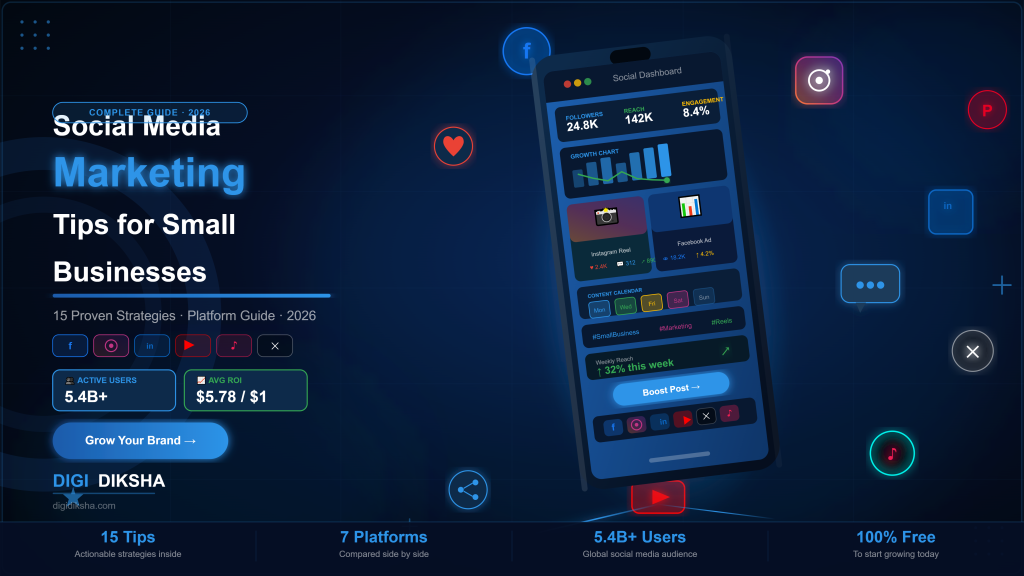
Social Media Marketing Tips for Small Businesses

Introduction In this complete guide to social media marketing tips for small businesses, you will learn exactly what social media marketing is, why it matters, nine key benefits, fifteen actionable strategies with step-by-step implementation, a platform comparison, common mistakes to avoid, the top trends shaping 2026, and the best tools to make your efforts more efficient and effective. Let us get started. Social media marketing is no longer optional for small businesses — it is one of the most powerful and cost-effective tools available to build a brand, connect with customers, and grow revenue in 2026. With over 5.4 billion active social media users worldwide, platforms like Instagram, Facebook, LinkedIn, and TikTok have become the primary places where people discover new brands, research products, and make purchase decisions. For small businesses, social media offers something that traditional advertising never could: the ability to compete directly with larger brands on a fraction of the budget. A well-executed social media strategy builds brand awareness, generates leads, drives website traffic, and creates the kind of genuine customer relationships that turn first-time buyers into loyal advocates. What is Social Media Marketing? In simple terms, it is any marketing activity your business does on platforms like Instagram, Facebook, LinkedIn, YouTube, TikTok, Pinterest, or X (formerly Twitter). This includes posting photos and videos, responding to comments, running ad campaigns, sharing blog articles, collaborating with influencers, and using analytics to refine your approach. Organic vs Paid Social Media Marketing •       Organic social media marketing involves creating and posting content without           paying for distribution. Your reach depends on your follower base, content                   quality, and platform algorithms. It is ideal for building long-term brand                       authority and  community. •       Paid social media marketing involves spending money to show your content               to a targeted audience beyond your existing followers. Platforms like Facebook              Ads and Instagram Ads allow highly precise targeting by location, age,                          interests, and behavior. The most effective small business social media strategies combine both — organic content builds trust and community while paid advertising drives immediate reach and conversions. Why Every Small Business Should Use Social Media •       It levels the playing field — a small local business can reach thousands of people           with great content•       It is where your customers already spend their time every single day•       It builds brand personality, trust, and loyalty over time•       It offers measurable, trackable results unlike traditional advertising•       It drives both online sales and offline foot traffic for local businesses Benefits of Social Media Marketing for Small Businesses •       Brand Awareness: Consistent posting and engagement exposes your brand to new audiences regularly. A local bakery that posts daily Stories of its products quickly becomes the go-to name in its neighborhood. •       Increased Website Traffic: Every post, bio link, and Story link sticker is an opportunity to send followers to your website, product pages, or blog. •       Lead Generation: Instagram Lead Ads, Facebook forms, and LinkedIn outreach allow businesses to collect qualified leads directly inside the platform. •       Customer Engagement: Polls, Q&As, comments, and DMs create two-way conversations that build genuine relationships between your brand and your customers. •       Cost-Effective Marketing: Organic social media is essentially free, and even paid ads can be launched with budgets as low as $5–$10 per day, making it accessible for any small business. •       Better Customer Relationships: Responding to comments and messages personally shows customers that a real person is behind the brand, building trust and loyalty. •       Higher Conversion Rates: Instagram Shopping tags and Facebook Shops allow customers to purchase directly from posts, reducing friction between discovery and purchase. •       Improved Brand Trust: A consistent, professional, and active social media presence signals credibility to potential customers who are researching before they buy. •       Measurable Results: Every platform provides analytics showing exactly how many people saw your content, clicked your links, or purchased from your store — allowing continuous data-driven improvement. Top 15 Social Media Marketing Tips for Small Businesses These fifteen strategies form the foundation of a complete social media marketing approach. Implement them consistently and you will see measurable growth in reach, engagement, and sales. Tip #1: Set Clear Marketing Goals Why it matters: Without clear goals, your social media activity becomes random and unmeasurable. Goals give your content strategy direction and allow you to measure what is actually working.How to implement it: Define SMART goals (Specific, Measurable, Achievable, Relevant, Time-bound). Examples include: gain 500 new Instagram followers in 90 days; generate 50 leads per month from LinkedIn; drive 1,000 website visits per month from Facebook.Example: A local gym sets a goal to increase class bookings by 30% over three months using Instagram Reels showcasing real member workouts.Pro tip: Review your goals monthly and adjust your content strategy based on which platforms and formats are actually moving the numbers. Tip #2: Understand Your Target Audience Why it matters: Creating content without knowing your audience is like speaking to an empty room. Deep audience understanding is what makes every post relevant, engaging, and worth the viewer’s time.How to implement it: Build a detailed buyer persona including age range, location, interests, pain points, preferred platforms, and peak online hours. Use Instagram Insights, Facebook Audience Insights, and Google Analytics to confirm your assumptions with real data.Example: A skincare brand discovers through Insights that 80% of its engaged audience is women aged 25-34 who follow wellness accounts, prompting a shift to clean beauty educational content.Pro tip: Survey your existing customers directly using Instagram Story polls or a simple email questionnaire. Real customers give you the most accurate audience data available. Tip #3: Choose the Right Social Media Platforms Why it matters: Being everywhere at once dilutes your effort and quality. Focus on the one or two platforms where

Social Media Marketing, Uncategorized

Instagram Marketing Strategies for Small Businesses

Introduction If your small business isn’t actively using Instagram in 2026, you are leaving a meaningful amount of brand awareness, leads, and sales on the table. Instagram has evolved far beyond a photo-sharing app — it is now a discovery engine, a customer service channel, and an in-app storefront, all at once.For small businesses specifically, Instagram offers something rare in digital marketing: the ability to reach new, highly relevant audiences organically, without a large advertising budget. A well-executed Reel can reach thousands of potential customers who have never heard of your brand before, something that is increasingly difficult to achieve on other platforms without paid spend.In this guide, you’ll learn exactly how to set up a business profile correctly, which of the 14 core Instagram marketing strategies matter most, how Instagram SEO actually works in 2026, what to expect from Instagram Ads, and how real local businesses, restaurants, salons, e-commerce brands, and agencies are using the platform to grow. Whether you’re starting from zero followers or trying to break through a growth plateau, this guide is built to be the most complete resource you’ll need. Why Instagram Matters for Small Businesses Type your paragraph hereWhy Instagram Matters for Small BusinessesInstagram remains one of the most valuable platforms for small business marketing, and the numbers back it up.• Massive user base: Instagram has well over two billion monthly active users globally, putting nearly any target audience within reach.•       Brand awareness: Visual storytelling through Reels and Stories builds recognition far faster than text-based platforms.• Customer engagement: Features like polls, comments, and DMs create direct, two-way relationships with customers.• Lead generation: Bio links, contact buttons, and lead-focused ad campaigns turn followers into inquiries.• Sales opportunities: Instagram Shopping and product tagging let users discover and purchase without leaving the app.• Local business growth: Location tags, local hashtags, and Instagram SEO make it easier than ever for nearby customers to find you.Most importantly, a majority of Instagram users report discovering new brands and products directly on the platform — making it a genuine top-of-funnel discovery channel, not just a place to post for existing customers. Setting Up an Instagram Business Account Before any strategy can work, your foundation needs to be set up correctly. Here’s what to get right from day one:Creating a Business Profile:-Switch to a Business or Creator account through Settings to unlock analytics, contact buttons, and ad capabilities that personal accounts don’t have.Optimizing Your Bio:-Use your bio’s limited space to clearly state who you help and how, include a relevant keyword, and end with a simple call to action.Profile Photo Best Practices:-Use a clear, recognizable logo or a high-quality headshot for service providers — avoid busy or low-resolution images that shrink poorly at thumbnail size.Contact Information:-Add a business email, phone number, and physical address (if applicable) so the Contact button appears directly on your profile.Website Links:-Use your single bio link strategically — a link-in-bio tool can route visitors to multiple destinations like your shop, booking page, or latest post.Instagram Highlights:-Organize your best Stories into Highlights by category (e.g., Reviews, FAQs, Products, Behind the Scenes) so new visitors can find key information instantly. Business Account Setup Checklist:-☐  Switched to a Business or Creator account☐  Added a clear, high-quality profile photo☐  Written a keyword-rich, benefit-driven bio☐  Added contact email, phone, and/or address☐  Set up a link-in-bio tool or direct website link☐  Created at least 3–5 organized Highlight categories☐  Connected Facebook Page (required for Shopping and ads) Instagram Marketing Strategies for Small Businesses These 14 strategies form the foundation of a complete Instagram marketing approach — from audience research through analytics. Implement them in roughly this order for the most natural progression. Strategy #1Define Your Target Audience Every effective Instagram strategy starts with knowing exactly who you’re talking to. Without a clear audience, content becomes generic, engagement drops, and ad spend gets wasted on the wrong people. How to implement it:      1. Review your existing customer base to identify common demographics and                  interests.      2. Study the followers of two or three direct competitors for patterns.      3. Build a simple buyer persona: age range, location, interests, pain points.      4. Use Instagram Insights’ Audience tab to confirm who is actually engaging with               you.Example: A boutique skincare brand discovers most of its engaged followers are women aged 25–34 interested in clean beauty, so it shifts content to focus squarely on that niche instead of beauty in general. Common mistake: Trying to appeal to “everyone” instead of a clearly defined niche, which dilutes messaging and lowers engagement.e Strategy #2: Create a Consistent Brand Identity Visual and tonal consistency is what makes a business instantly recognizable as someone scrolls past dozens of posts a minute. Consistency builds trust before a single word is read.How to implement it:            1.    Choose two or three brand colors and one or two fonts and use them                           everywhere.            2.    Define a content voice (playful, premium, educational) and stick to it.            3.    Create reusable templates for Stories, Reels covers, and carousels.            4.    Design a consistent Highlight cover style that matches your brand. Example: A coffee shop uses the same warm color palette and typography across every single post, so customers recognize its content instantly even without seeing the logo. Common mistake: Constantly changing visual style, fonts, or filters so the feed looks disjointed and unprofessional. Strategy #3: Develop a Content StrategyRandom, unplanned posting underperforms. A documented content strategy keeps your account aligned with business goals and makes content creation faster and less stressful.How to implement it:          1.    Build 4–5 content pillars (education, behind-the-scenes, product, UGC,                           promotions).          2.    Create a simple weekly or monthly content calendar.   

wpChatIcon
wpChatIcon
Scroll to Top