
Content Marketing

Content Marketing

How to Create a Content Strategy That Drives Leads: The Complete Step-by-Step Guide

Introduction Most businesses publish content regularly, yet few turn that content into real leads. The gap usually isn’t effort, it’s strategy. This guide walks through a step-by-step process for building a content strategy that consistently attracts, nurtures, and converts your ideal customers. What Is a Content Strategy? A content strategy is a documented plan that guides what you create, why you create it, and how it moves prospects toward a purchase. Content marketing is the execution; content strategy is the roadmap that makes that execution effective. Why Content Strategy Matters for Lead Generation Builds trust through consistent, valuable content Improves SEO visibility and organic traffic Attracts qualified leads instead of random visitors Nurtures prospects through the buyer journey Builds long-term brand authority and thought leadership Understanding Your Target Audience Start by identifying your ideal customer’s pain points, goals, and buying behavior. Build a simple buyer persona covering their role, challenges, and the questions they search for online, then map content to each stage of their journey. Set SMART Content Marketing Goals Effective goals are Specific, Measurable, Achievable, Relevant, and Time-bound. For example: ‘Increase organic blog leads by 20% within the next quarter’ gives your team a clear, trackable target. Perform Keyword Research Keyword research reveals what your audience is actually searching for. Use tools like Google Keyword Planner, Ahrefs, SEMrush, and AnswerThePublic to find long-tail keywords, understand search intent, and analyze competitor content gaps. Conduct a Content Audit Review all existing content for performance Identify content gaps and outdated pages Update or merge underperforming articles Remove or redirect duplicate content Build a Lead-Generating Content Funnel Top of Funnel (TOFU): Educational blogs, guides, and videos that attract new visitors and build awareness. Middle of Funnel (MOFU): Webinars, case studies, and email sequences that build trust and nurture interest. Bottom of Funnel (BOFU): Product demos, testimonials, and landing pages that convert ready buyers. Create a Content Calendar Plan content monthly, choose a realistic publishing frequency, assign clear ownership, and repurpose high-performing content into new formats to maximize reach with less extra effort. Create High-Converting Content Blog posts and guides for organic search traffic Case studies and testimonials for trust-building Lead magnets like checklists and templates Landing pages with clear, focused CTAs Email campaigns for nurturing and re-engagement Optimize Content for SEO Strong on-page SEO includes natural keyword placement, clear header structure, internal and external linking, optimized meta titles and descriptions, and image alt text. These fundamentals help both search engines and readers understand your content. Content Distribution Strategy Great content still needs promotion. Share it through email marketing, LinkedIn, relevant communities, guest posts, and influencer collaborations to extend reach beyond organic search alone. Lead Generation Techniques Offer free templates, checklists, and audits Use webinars and newsletters to capture emails Add clear, benefit-driven CTAs throughout content Use exit-intent popups thoughtfully, not aggressively Measuring Content Performance Organic traffic and bounce rate Time on page and engagement rate Conversion rate and leads generated Customer acquisition cost (CAC) and ROI Track these using Google Analytics 4, Google Search Console, and tools like HubSpot or Semrush. Common Content Strategy Mistakes Publishing without a documented strategy Ignoring search intent behind keywords Inconsistent publishing schedules Weak or missing calls-to-action Never updating older, outdated content Skipping analytics review entirely Frequently Asked Questions How does content generate leads? Content attracts visitors through search, builds trust with useful information, and converts them via CTAs, lead magnets, and landing pages. How often should I publish content? Consistency matters more than frequency; one high-quality post per week outperforms sporadic, rushed publishing. Can small businesses build an effective content strategy? Yes. A focused strategy targeting a specific niche and audience often outperforms broad, unfocused content from larger competitors Conclusion A strong content strategy turns scattered publishing into a predictable lead-generation engine. Define your audience, map your funnel, optimize for SEO, and measure results consistently to build sustainable, long-term growth. Build Your Content Strategy With DIGIDIKSHA DIGIDIKSHA offers expert content marketing, SEO, lead generation, and complete digital marketing services to help your business attract and convert the right audience. Contact us today to schedule a consultation and build a content strategy that drives consistent, high-quality leads.
Content Marketing

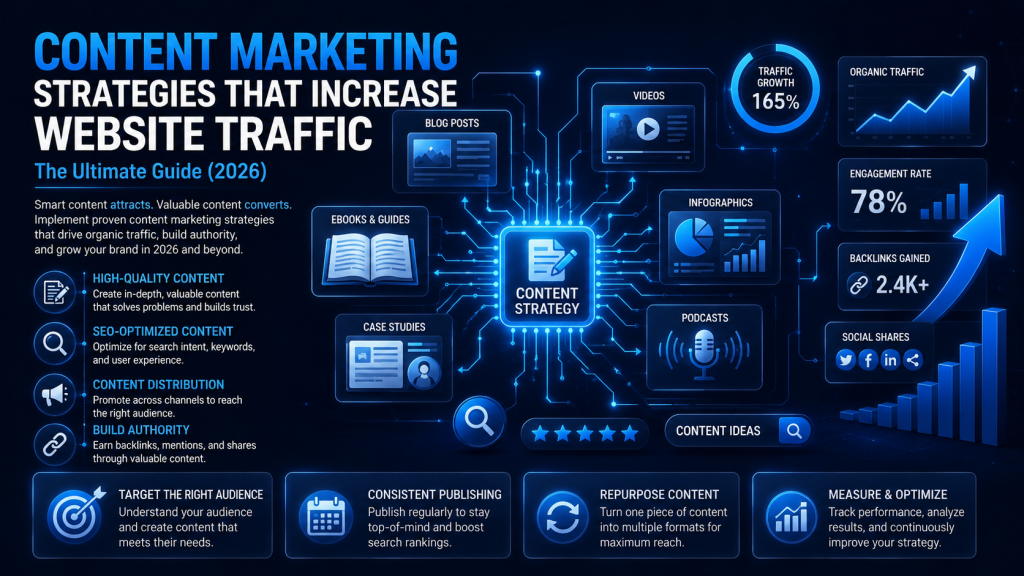
Content Marketing Strategies That Increase Website Traffic: The Ultimate Guide (2026)

Introduction Every business owner asks the same question at some point: how do you get more people to visit your website without spending a fortune on ads? The answer, for most brands that succeed online in 2026, is content marketing. Content marketing is the practice of creating and sharing valuable, relevant material such as blog posts, videos, guides, and infographics to attract, engage, and retain a clearly defined audience. Quality content matters more than ever this year because search engines, especially Google, now reward genuinely helpful information over thin, keyword-stuffed pages. With AI Overviews reshaping search results and audiences growing more selective about what they read, brands that publish consistent, trustworthy content win the long game. Content marketing strategies that increase website traffic don’t rely on quick tricks; they compound over months and years, turning a handful of well-optimized articles into a steady stream of visitors, leads, and customers. In this guide, you’ll learn what content marketing really means, why it drives sustainable traffic growth, the top 15 content marketing strategies that increase website traffic, common mistakes to avoid, the latest trends shaping the industry, and the tools professionals use to get results. What is Content Marketing? Content marketing is a strategic approach to creating and distributing valuable, relevant, and consistent content to attract and retain a clearly defined audience, ultimately driving profitable customer action. Unlike traditional advertising, which interrupts people with a sales pitch, content marketing earns attention by solving problems and answering questions first. This distinction matters because audiences today are skeptical of overt advertising but receptive to brands that genuinely help them. A billboard or a paid banner asks for attention; a well-written how-to guide or an in-depth comparison article gives value before asking for anything in return. That single shift, from interrupting to informing, is what allows content marketing to build lasting trust and authority. Over time, a business that consistently publishes helpful content becomes the go-to resource in its niche. When readers repeatedly find useful answers on your website, they begin to trust your brand’s expertise, and that trust naturally extends to your products and services. A Practical Example Imagine two competing accounting software companies. Company A only runs paid ads promoting its features. Company B publishes weekly blog posts on topics like “How Small Businesses Can Simplify Tax Filing” and “Common Bookkeeping Mistakes to Avoid.” Over a year, Company B’s articles start ranking on Google for dozens of relevant searches, bringing in thousands of free visitors every month, many of whom convert into paying customers because they already trust the brand’s expertise. Company A keeps paying for every single click. This is the compounding advantage of content marketing. Why Content Marketing is Important for Website Traffic Content marketing isn’t just a nice-to-have; it’s one of the most cost-effective ways to grow website traffic sustainably. Here’s why it matters so much for driving visitors to your site. •        Improves organic search rankings by consistently targeting keywords your                    audience is searching for•        Increases website visitors as more pages become discoverable through search              engines•        Builds brand awareness by putting your name in front of people at every stage              of their research•        Generates qualified leads by attracting people who are actively looking for                    solutions you offer•        Improves customer trust because helpful, accurate content signals genuine                    expertise•        Supports broader SEO efforts by creating natural opportunities for internal                    linking and keyword coverage•        Encourages social sharing, which extends your reach beyond your existing                    audience•        Delivers long-term ROI, since a single well-optimized article can attract traffic                for years Consider HubSpot, a company that built much of its early growth on free blog content and downloadable guides rather than paid advertising alone. By answering the exact questions its target audience was typing into Google, it turned its blog into one of the biggest traffic-generating assets of the entire business, a pattern now replicated by countless companies across industries. Top 15 Content Marketing Strategies That Increase Website Traffic Below are the 15 most effective content marketing strategies for driving consistent, long-term traffic growth. 1. Understand Your Target AudienceEvery successful content strategy starts with a clear picture of who you’re writing for. Audience research involves studying demographics, pain points, goals, and online behavior so you can create content that genuinely resonates.Building detailed buyer personas, fictional profiles representing your ideal customers, helps you make consistent decisions about topics, tone, and format. Just as important is understanding search intent: are readers looking to learn something, compare options, or make a purchase? Matching your content to that intent is what separates articles that rank from articles that don’t. 2. Perform Keyword ResearchKeyword research is the foundation of any content marketing strategy that increases website traffic. Short-tail keywords (like “content marketing”) are broad and highly competitive, while long-tail keywords (like “content marketing strategies for small businesses”) are more specific and easier to rank for.Understanding search intent, whether a searcher wants information, a comparison, or to make a purchase, ensures your content matches what people actually want. Keyword clustering, grouping related keywords under one comprehensive piece of content, helps you rank for dozens of variations with a single article. Tools like Google Keyword Planner and Ahrefs make it easy to uncover search volume, difficulty, and related terms. 3. Create High-Quality, Helpful ContentGoogle’s guidelines increasingly reward original, people-first content. This means your writing should reflect real experience, expertise, authoritativeness, and trustworthiness, commonly known as EEAT.Rather than rehashing what’s already ranking, aim to add a unique perspective, original research, or practical examples. The goal is always to solve a genuine problem or answer a real question your audience is asking, not simply to hit a word count.

Content Marketing

Why Quality Beats Quantity in Content Marketing — and Why It Matters More Than Ever in 2026

The internet doesn’t need more content. It needs better content. Here’s the data-backed case for publishing less — but publishing smarter. Let’s be honest for a moment. At some point in the last few years, content marketing became a volume game. Businesses were told: publish more, post daily, fill your blog, dominate the feed. So they did. They hired writers, subscribed to AI tools, and started producing content at a pace that would make a newsroom blush.And most of them got almost nothing in return. Here’s the uncomfortable truth: more content has never automatically meant more results. In 2026, with AI tools capable of generating a thousand blog posts overnight, the brands that win aren’t the ones publishing the most — they’re the ones publishing the best. In this article, we’re going to break down exactly why the quality-over-quantity shift isn’t just a content trend — it’s the only strategy that makes sense right now. We’ll look at the data, explain what “quality” actually means in practice, and give you a clear framework for making the switch. No fluff. No filler. Just the real stuff. The Content Flood Is Real — and It’s Getting Worse Think about how much content gets published every single day. Millions of blog posts. Billions of social media updates. Thousands of YouTube videos. And now, with AI writing tools costing less than a coffee subscription, that number has exploded beyond anything we’ve seen before.Every niche is saturated. Every topic has been covered. Every keyword has been targeted. And search engines — not to mention real human readers — have become extraordinarily good at filtering out the noise. Part of the reason is inertia. Content calendars are built around posting frequency. Social media managers are measured by how often they post. Blog strategies are judged by article count. The metrics we’ve historically used to measure content marketing effort are all about how much — not how good. That’s the mindset that needs to change. And fast. What Does “Quality Content” Actually Mean? Here’s where a lot of businesses get stuck. They nod along to “quality over quantity” — and then write the same surface-level, keyword-stuffed, listicle-style posts they always have, just… less often. That’s not quality. That’s just less quantity. Real quality in content marketing in 2026 means meeting a much higher bar across five dimensions: The Business Case: What Quality Content Actually Delivers Let’s talk results. Because quality content isn’t just a philosophical preference — it produces measurably better outcomes. Here’s what the data shows: That’s not a marginal improvement. That’s a completely different tier of performance. And it makes intuitive sense when you think about it — content that genuinely helps someone make a decision is infinitely more valuable than content that exists purely to fill a publishing schedule. There’s also the long-term compounding effect to consider. A well-researched, deeply useful article written today will still be driving traffic in three years. A thin, generic post designed to hit a weekly quota disappears into the void within weeks, never to be found again. Quality content is an asset. Quantity content is a cost. +40% traffic Publishing in-depth, optimised pieces consistently yields significantly more organic traffic and builds your brand into a go-to industry resource — rather than just another blog nobody remembers. And here’s the cost argument, too. Fewer, better pieces require less production time and budget per piece (when you factor in the total return), are cheaper to promote effectively, easier to build links to, and far more likely to get shared by real people. Less truly can be more — when the less you’re producing is genuinely excellent. here Why Quantity Is Especially Broken Right Now The quality vs. quantity debate isn’t new. But three forces converging in 2026 have made the volume-first approach more broken than it’s ever been. 1. AI Has Flooded Every Channel This is the big one. AI content tools have lowered the cost of production to almost zero. Which means every competitor in your space can now publish ten times more content than they could three years ago. The result? An internet drowning in average. Search engines are swimming in thin, repetitive, AI-generated articles — and they’re getting better at identifying and filtering them out by the day.The data underlines the opportunity this creates: human-generated, genuinely original content now receives 5.44 times more traffic than AI-generated content. In a world where AI has made the floor accessible to everyone, being authentically, unmistakably human is the new competitive advantage. 2. Search Has Fundamentally Changed Google’s AI Overviews, featured snippets, and generative search results now pull directly from the most authoritative, well-structured, comprehensive sources. A blog post that only scratches the surface of a topic — no matter how well-optimised its title tag is — won’t get cited. It won’t get featured. It effectively doesn’t exist.The shift to topic clusters over isolated keyword targeting reflects this reality. Depth and topical authority now matter more than any individual piece’s keyword density. 3. Audiences Have Developed Excellent Taste Readers in 2026 have been swimming in content for years. They can smell a surface-level take from the first paragraph. They know when something is genuinely useful versus when it was written to fill a slot on a content calendar. Engagement — the metric that actually matters — has become impossible to fake. Quality vs. Quantity: The Direct Comparison Here’s what these two approaches look like side by side in practice: How to Make the Shift: A Practical Framework Knowing quality beats quantity is one thing. Actually building a content operation that delivers it consistently is another. Here’s a six-step framework to make the transition without losing momentum: What This Means for Your Business Right Now TyHere’s the opportunity hidden inside this shift: most businesses haven’t made it yet.pe your paragraph here Only 41% of B2B marketers currently have a documented content marketing strategy — yet having one correlates with 2.6 times higher success rates. The majority of your competitors are still operating

wpChatIcon
wpChatIcon
Scroll to Top