
Introduction
If your small business isn't actively using Instagram in 2026, you are leaving a meaningful amount of brand awareness, leads, and sales on the table. Instagram has evolved far beyond a photo-sharing app — it is now a discovery engine, a customer service channel, and an in-app storefront, all at once.For small businesses specifically, Instagram offers something rare in digital marketing: the ability to reach new, highly relevant audiences organically, without a large advertising budget. A well-executed Reel can reach thousands of potential customers who have never heard of your brand before, something that is increasingly difficult to achieve on other platforms without paid spend.In this guide, you'll learn exactly how to set up a business profile correctly, which of the 14 core Instagram marketing strategies matter most, how Instagram SEO actually works in 2026, what to expect from Instagram Ads, and how real local businesses, restaurants, salons, e-commerce brands, and agencies are using the platform to grow. Whether you're starting from zero followers or trying to break through a growth plateau, this guide is built to be the most complete resource you'll need.
Why Instagram Matters for Small Businesses
Type your paragraph hereWhy Instagram Matters for Small BusinessesInstagram remains one of the most valuable platforms for small business marketing, and the numbers back it up.
• Massive user base: Instagram has well over two billion monthly active users globally, putting nearly any target audience within reach.• Brand awareness: Visual storytelling through Reels and Stories builds recognition far faster than text-based platforms.
• Customer engagement: Features like polls, comments, and DMs create direct, two-way relationships with customers.
• Lead generation: Bio links, contact buttons, and lead-focused ad campaigns turn followers into inquiries.
• Sales opportunities: Instagram Shopping and product tagging let users discover and purchase without leaving the app.
• Local business growth: Location tags, local hashtags, and Instagram SEO make it easier than ever for nearby customers to find you.Most importantly, a majority of Instagram users report discovering new brands and products directly on the platform — making it a genuine top-of-funnel discovery channel, not just a place to post for existing customers.
Setting Up an Instagram Business Account
Before any strategy can work, your foundation needs to be set up correctly. Here's what to get right from day one:
Creating a Business Profile:-
Switch to a Business or Creator account through Settings to unlock analytics, contact buttons, and ad capabilities that personal accounts don't have.
Optimizing Your Bio:-
Use your bio's limited space to clearly state who you help and how, include a relevant keyword, and end with a simple call to action.
Profile Photo Best Practices:-
Use a clear, recognizable logo or a high-quality headshot for service providers — avoid busy or low-resolution images that shrink poorly at thumbnail size.
Contact Information:-
Add a business email, phone number, and physical address (if applicable) so the Contact button appears directly on your profile.
Website Links:-
Use your single bio link strategically — a link-in-bio tool can route visitors to multiple destinations like your shop, booking page, or latest post.
Instagram Highlights:-
Organize your best Stories into Highlights by category (e.g., Reviews, FAQs, Products, Behind the Scenes) so new visitors can find key information instantly.
Business Account Setup Checklist:-
☐ Switched to a Business or Creator account
☐ Added a clear, high-quality profile photo
☐ Written a keyword-rich, benefit-driven bio
☐ Added contact email, phone, and/or address
☐ Set up a link-in-bio tool or direct website link
☐ Created at least 3–5 organized Highlight categories
☐ Connected Facebook Page (required for Shopping and ads)
Instagram Marketing Strategies for Small Businesses
These 14 strategies form the foundation of a complete Instagram marketing approach — from audience research through analytics. Implement them in roughly this order for the most natural progression.
Strategy #1Define Your Target Audience
Every effective Instagram strategy starts with knowing exactly who you're talking to. Without a clear audience, content becomes generic, engagement drops, and ad spend gets wasted on the wrong people.
How to implement it:
1. Review your existing customer base to identify common demographics and interests.
2. Study the followers of two or three direct competitors for patterns.
3. Build a simple buyer persona: age range, location, interests, pain points.
4. Use Instagram Insights' Audience tab to confirm who is actually engaging with you.
Example:
A boutique skincare brand discovers most of its engaged followers are women aged 25–34 interested in clean beauty, so it shifts content to focus squarely on that niche instead of beauty in general.
Common mistake:
Trying to appeal to “everyone” instead of a clearly defined niche, which dilutes messaging and lowers engagement.e
Strategy #2: Create a Consistent Brand Identity
Visual and tonal consistency is what makes a business instantly recognizable as someone scrolls past dozens of posts a minute. Consistency builds trust before a single word is read.
How to implement it:
1. Choose two or three brand colors and one or two fonts and use them everywhere.
2. Define a content voice (playful, premium, educational) and stick to it.
3. Create reusable templates for Stories, Reels covers, and carousels.
4. Design a consistent Highlight cover style that matches your brand.
Example:
A coffee shop uses the same warm color palette and typography across every single post, so customers recognize its content instantly even without seeing the logo.
Common mistake:
Constantly changing visual style, fonts, or filters so the feed looks disjointed and unprofessional.
Strategy #3: Develop a Content Strategy
Random, unplanned posting underperforms. A documented content strategy keeps your account aligned with business goals and makes content creation faster and less stressful.
How to implement it:
1. Build 4–5 content pillars (education, behind-the-scenes, product, UGC, promotions).
2. Create a simple weekly or monthly content calendar.
3. Batch-create content in advance to stay consistent.
4. Maintain an 80/20 ratio: 80% value-driven content, 20% promotional.
Example: A fitness studio plans weekly pillars: Monday workout tips, Wednesday client transformations, Friday class promotions — giving followers a predictable, valuable rhythm.
Common mistake: Posting only promotional, sales-driven content, which trains followers to tune the account out.
Strategy #4: Use Instagram Reels for Maximum Reach
Instagram's algorithm actively prioritizes Reels for reach beyond your existing follower base, making it the single most powerful discovery tool available to small businesses in 2026.
How to implement it:
1. Use trending audio early, while it still has momentum.
2. Hook viewers in the first 3 seconds with a question, visual, or bold statement.
3. Keep most Reels between 15–30 seconds for stronger completion rates.
4. Add on-screen captions, since most users watch with sound off.
5. Post 3–5 Reels per week for consistent algorithmic favor.
Example: A local bakery's behind-the-scenes Reel of decorating a custom cake gets reshared across dozens of accounts, reaching thousands of non-followers in a single day.
Common mistake: Posting Reels without a strong opening hook, causing viewers to scroll away within the first few seconds.aph here
Strategy #5: Post High-Quality Visual Content
Your visuals are often a potential customer's very first impression of your brand's professionalism and credibility — before they read a single caption.
How to implement it:
1. Shoot in natural light whenever possible.
2. Use a consistent editing preset or filter across posts.
3. Invest in a basic smartphone gimbal or simple lighting kit.
4. Maintain a consistent aspect ratio and crop style across the feed.
Example: An e-commerce store reshoots its product photography against a consistent neutral background, and saves and shares on those posts increase noticeably.
Common mistake: Posting low-resolution, poorly lit, or visually inconsistent images that quietly undercut brand credibility.
Strategy #6: Use Story Features Effectively
Stories sit at the very top of the app and are often the most-viewed content format, making them a daily opportunity to stay top-of-mind with your audience.
How to implement it:
1. Use polls, quizzes, and question stickers to invite interaction.
2. Post Stories daily, even if it's just a quick update.
3. Use countdown stickers to build anticipation for launches or sales.
4. Pin your best Stories to Highlights organized by category.
Example: A nail salon uses a poll sticker asking followers which color to feature next, turning a simple Story into a two-way conversation that boosts engagement.
Common mistake: Rarely posting Stories and missing out on some of the most-viewed real estate the app offers.
Strategy #7: Leverage User-Generated Content
User-generated content (UGC) builds social proof that no branded post can replicate, and it dramatically reduces the burden of constantly creating original content.
How to implement it:
1. Create a branded hashtag and encourage customers to use it.
2. Always ask permission before reposting a customer's content.
3. Feature UGC regularly in Stories and dedicated feed posts.
4. Incentivize sharing with the promise of a feature or shoutout.
Example: An apparel brand reposts customer outfit photos tagged with its branded hashtag every week, turning happy customers into an ongoing content engine.
Common mistake: Reposting customer content without crediting or asking permission first, which can damage trust and relationships.re
Strategy #8: Collaborate with Influencers
Influencer partnerships let a small business borrow an already-established audience's trust, and micro-influencers make this accessible even on a modest budget.
How to implement it:
1. Identify local or niche micro-influencers (roughly 1,000–50,000 followers).
2. Reach out with a clear, simple collaboration proposal.
3. Offer product-for-post trades or a modest paid fee, depending on reach.
4. Use Instagram's built-in Collab feature so the post appears on both profiles.
Example: A local restaurant invites a food micro-influencer in for a free tasting in exchange for an honest Reel review, generating a wave of new local followers.
Common mistake: Chasing only mega-influencers whose broad, mismatched audience does not convert despite the high cost.
Strategy#9: Use Hashtags Strategically
Hashtags remain one of the simplest ways to expand discoverability beyond your existing follower base and surface in relevant Explore feeds.
How to implement it:
1. Mix broad, niche-specific, and branded hashtags (8–15 total works well).
2. Research which hashtags competitors and similar accounts are using successfully.
3. Rotate a few different hashtag sets rather than reusing the exact same list.
4. Avoid banned, spammy, or wildly oversaturated tags.
Example: A yoga studio uses location-specific tags like #austinyoga alongside niche tags instead of generic, oversaturated tags like #fitness.
Common mistake: Using the exact same 30 generic hashtags on every single post, which signals low effort to the algorithm.agraph here
Strategy #10: Engage With Followers Daily
Instagram's algorithm rewards accounts that generate genuine two-way conversation, and consistent engagement is what turns casual followers into loyal customers.
How to implement it:
1. Respond to comments and DMs within 24 hours whenever possible.
2. Spend 10–15 minutes daily liking and commenting on followers' and local accounts' posts.
3. Use Story reply stickers to spark direct conversation.
4. Treat every comment as a potential customer service or sales touchpoint.
Example: A bakery personally responds to every single comment, and several frequent commenters become regular in-store customers as a direct result.
Common mistake: Posting content and then disappearing, leaving comments and DMs unanswered for days.
Strategy #11: Run Instagram Contests and Giveaways
Well-run giveaways can rapidly boost followers, engagement, and visibility, especially when entry requires sharing or tagging others.
How to implement it:
1. Choose a prize genuinely relevant to your target audience, not just anything flashy.
2. Require entries like following, tagging friends, or sharing to Stories.
3. Follow Instagram's official promotion guidelines to stay compliant.
4. Announce the winner publicly to maintain trust and transparency.
Example: A small jewelry brand's giveaway requiring participants to tag three friends nearly doubles its follower count within a single week
.Common mistake: Offering vague rules or prizes unrelated to your products, which attracts prize-hunters rather than future customers.
Strategy #12: Use Instagram Shopping Features
Instagram Shopping turns the platform into a direct sales channel, removing friction between discovery and purchase.
How to implement it:
1. Set up a product catalog through Meta Commerce Manager.
2. Tag products directly in feed posts, Reels, and Stories.
3. Enable in-app checkout where it's available in your region.
4. Use shopping stickers in Stories to drive immediate clicks.
Example: An e-commerce store tags products directly inside its Reels, allowing viewers to tap straight through to checkout without ever leaving the app.
Common mistake: Failing to tag products consistently across content, leaving easy, low-friction sales on the table.
Strategy #13: Optimize for Instagram SEO
Instagram has evolved into a genuine search engine in its own right, and optimized profiles and captions now surface directly in both Instagram search and Google results.
How to implement it:
1. Add a relevant keyword to your name field, not just your username.
2. Write descriptive, keyword-rich captions instead of generic one-liners. 3. Add alt text to images describing what's actually in them.
4. Use a handful of relevant, specific hashtags as supporting keywords.
Example: A local plumber adds “Plumber in Austin, TX” to the name field on their profile, and the account begins appearing in relevant Instagram and Google searches.
Common mistake: Using a vague username and bio with zero searchable keywords, making the account effectively invisible in search.
Strategy #14: Track Analytics and Improve Performance
Data reveals what is actually working versus what merely feels like it's working, and that distinction is what separates accounts that grow from those that stall.
How to implement it:
1. Review Instagram Insights weekly: reach, saves, shares, and profile visits.
2. Identify which content format consistently outperforms the rest.
3. Test different posting times and track the impact on reach.
4. Revisit and adjust your overall strategy every quarter based on the data.
Example: A clothing brand notices Reels generate five times the reach of static posts and shifts the bulk of its content production accordingly.
Common mistake: Never reviewing analytics at all, and unknowingly repeating content formats that consistently underperform.graph here
Instagram Reels Marketing Strategy
Why Reels Dominate Reach
Instagram's algorithm is built to surface Reels to users who don't yet follow an account, making Reels the single most effective tool for organic discovery in 2026.
Best Reel Content Ideas
• Quick tutorials or how-to demonstrations
• Trending audio paired with relevant visuals
• Before-and-after transformations
• Behind-the-scenes process videos
Reel Optimization Tips
• Hook viewers in the first 3 seconds
• Keep most Reels between 15–30 seconds
• Add on-screen text captions for sound-off viewing
• Use a clear call to action at the end
Posting Frequency
Aim for 3–5 Reels per week. Quality and consistency matter more than sheer volume — a handful of well-made Reels outperforms a daily stream of rushed ones.
Growth Tactics
• Repurpose top-performing Reels into Stories and feed posts
• Reply to comments with a Reel reply to extend engagement
• Collaborate with other accounts using the Collab feature
Instagram SEO Explained
Instagram has quietly become a search engine in its own right — both within the app and increasingly in Google's own results. Here's how Instagram SEO works in 2026:
• Keyword optimization: Identify the terms your ideal customers actually search for, and weave them naturally into your bio and captions.
• Username optimization: Keep your @username close to your actual business name for brand searches.
• Profile (name field) optimization: Add a descriptive keyword to your name field — this field is searchable and weighted more heavily than your bio text.
• Caption SEO: Write descriptive, keyword-rich captions instead of short, vague captions or emoji-only posts.
• Alt text: Add descriptive alt text to your images describing what's
actually shown — this improves both accessibility and discoverability.
• Hashtags: Use specific, relevant hashtags as supporting keywords rather than relying on hashtags alone for reach.
• Discoverability: Engagement signals (saves, shares, watch time) increasingly influence whether Instagram surfaces your content in Explore and search results.
Instagram Ads for Small Businesses
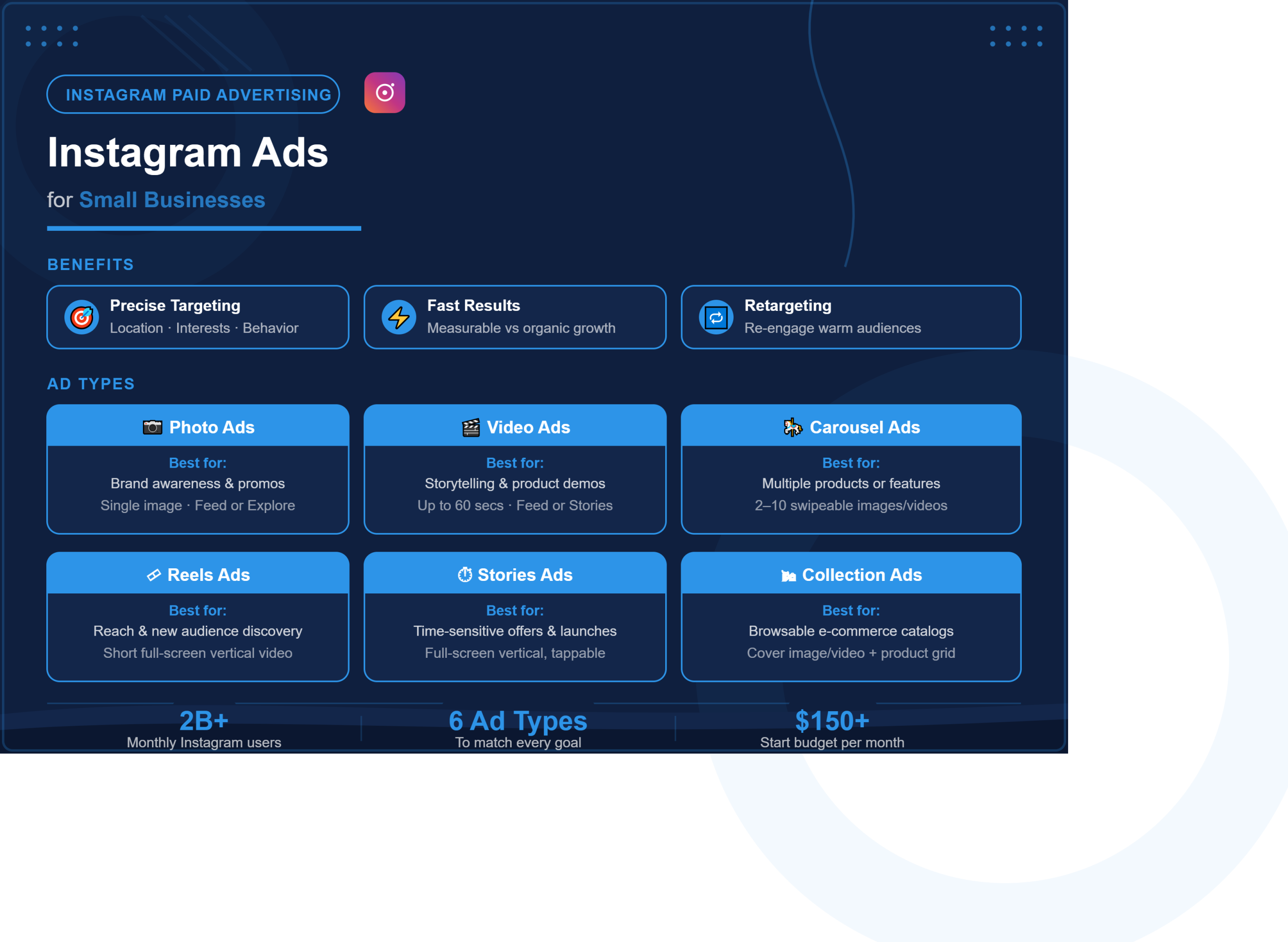
Paid advertising can accelerate results that organic strategies alone would take much longer to achieve, particularly for lead generation and retargeting.
Benefits
• Precise targeting by location, interests, and behavior
• Fast, measurable results compared to organic growth
• Ability to retarget people who already engaged with your content or site
Ad Types
Lead Generation Campaigns
Instagram Lead Ads let users submit their contact information directly within the app via a pre-filled form, removing the friction of navigating to an external landing page — ideal for service-based businesses.
Retargeting
Retargeting ads target people who already visited your website, engaged with your profile, or watched a video, generally producing a far lower cost- per-conversion than cold-audience campaigns.
Content Ideas for Small Businesses
Use this list of 50 content ideas — organized into five categories — whenever you need fresh inspiration for your content calendar.
General Post Ideas
• Product flat-lay photography
• Customer testimonial graphic
• Before-and-after transformation
• Team member spotlight
• Behind-the-scenes workspace photo
• Quote graphic reflecting brand values
• New product or service announcement
• Milestone celebration (anniversary, follower count)
• Local community event coverage
• Repost of standout user-generated content
Reel Ideas
• A day in the life of your business
• Quick how-to or tutorial
• Trending audio paired with a product reveal
• Before-and-after transformation video
• Customer reaction or testimonial clip
• Packing or unboxing an order
• Myth-busting a common industry misconception
• Three quick tips in under 30 seconds
• Meet-the-team or meet-the-maker intro
• Start-to-finish behind-the-scenes of a project
Story Ideas
• “This or that” poll comparing two products
• Countdown sticker to a launch or sale
• Q&A sticker for open customer questions
• Repost of a customer's tagged Story
• Quick behind-the-scenes clip
• New blog or product announcement with a link sticke
r• Quiz sticker testing industry knowledge
• Direct link sticker to shop a featured item
• Daily business update or “mood of the day”
• Sneak peek of an upcoming product
Promotional Content Ideas
• Limited-time discount announcement
• Bundle deal showcase
• Flash sale countdown post
• Referral program announcement
• Loyalty program highlight
• New arrival showcase
• Seasonal or holiday promotion
• Free-shipping threshold reminder
• Exclusive offer for email or DM subscribers
• Giveaway or contest announcement
Educational Content Ideas
• Industry tip of the week
• How your product or service solves a common problem
• FAQ answered in carousel format
• Step-by-step tutorial relevant to your niche
• Glossary of common industry terms
• DIY versus professional service comparison
• Common mistakes customers make (and how to avoid them)
• Useful checklist graphic for your audience
• Industry statistic or data slideExplainer of how your product is made or service is delivered
Common Instagram Marketing Mistakes
• Buying followers: Fake followers don't engage or buy, and they tank your engagement rate, which signals low quality to the algorithm.
• Inconsistent posting: Sporadic posting causes the algorithm to deprioritize your content and makes it harder for followers to build a habit around your account.
• Ignoring analytics: Without reviewing Insights regularly, you keep repeating content that doesn't work simply because you never measured it.
• Poor engagement: Posting without responding to comments or DMs signals to both followers and the algorithm that the account isn't actively managed.
• Over-promoting products: An overly salesy feed trains followers to scroll past your content instead of pausing to engage.
Instagram Marketing Trends for 2026
AI-Powered Content Creation
AI tools are increasingly used to generate captions, repurpose video into Reels, and even assist with basic editing — letting small businesses produce more content without expanding their team.
Continued Reels Growth
Reels remain Instagram's primary growth lever, with the algorithm continuing to favor short-form video for reaching audiences beyond existing followers.
Instagram SEO
Optimized profiles, captions, and alt text increasingly determine whether an account surfaces in both Instagram search and Google results, making Instagram SEO a core skill rather than an afterthought.
Social Commerce
In-app shopping, product tagging, and checkout continue to mature, making Instagram a direct sales channel rather than just a discovery tool.
Influencer Partnerships
Micro and nano-influencer collaborations continue to outperform mega-influencer deals on cost-per-engagement, particularly for local and niche small businesses.
Personal Branding
Founder-led, personal-branded content continues to outperform faceless corporate posts, as audiences increasingly trust people over logos.
Conclusion
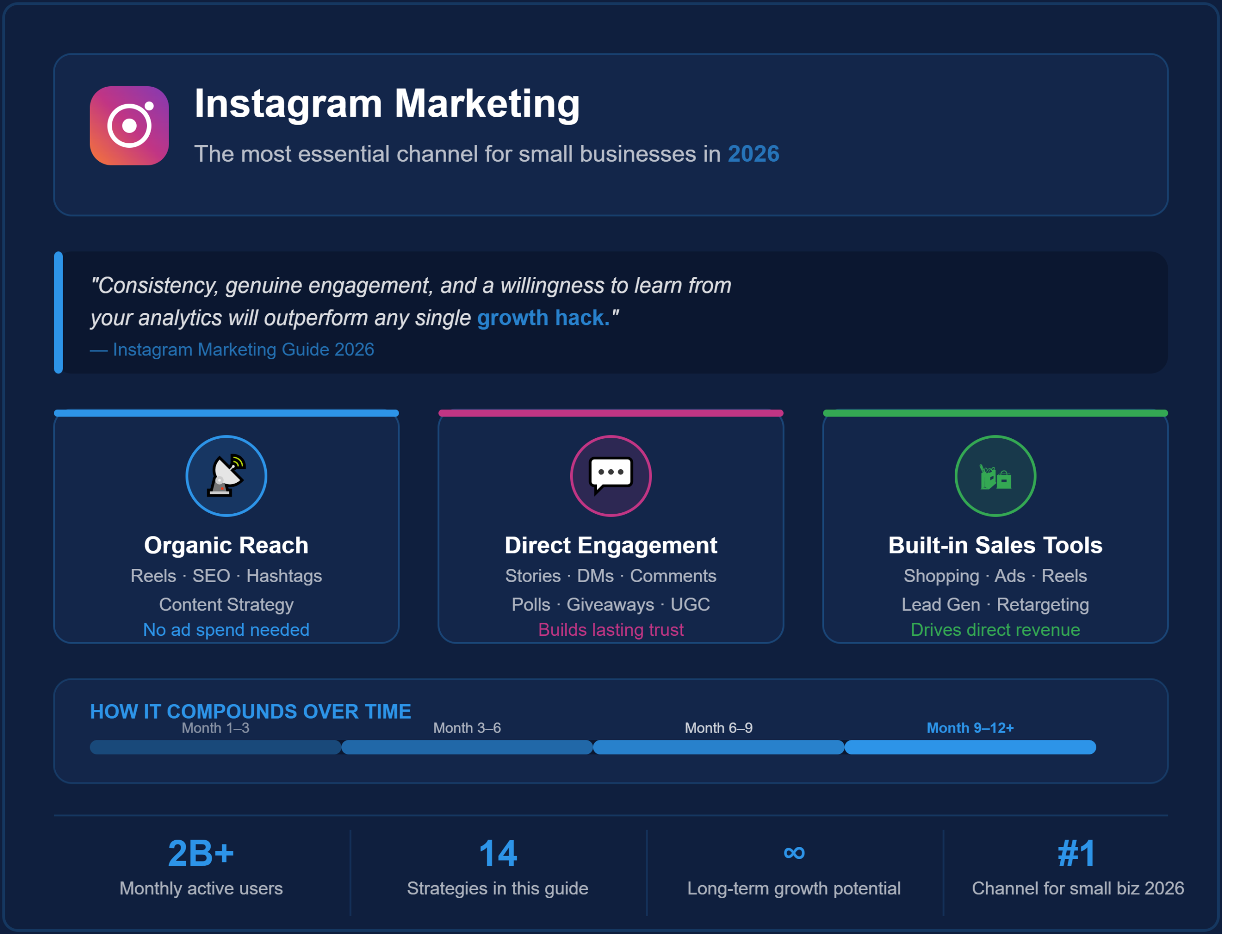
Instagram remains one of the most essential marketing channels available to small businesses in 2026, offering a rare combination of organic reach, direct customer engagement, and built-in sales tools that few other platforms match
.The Instagram marketing strategies for small businesses covered in this guide — from defining your audience and building a consistent brand identity, to mastering Reels, Instagram SEO, and paid ads — work best when applied together and consistently over time, rather than in isolated bursts.
Consistency, genuine engagement, and a willingness to learn from your own analytics will outperform any single “growth hack.” Start with the strategies that fit your current stage, track what actually moves the needle for your specific audience, and build from there. Done well, Instagram marketing compounds into one of the most reliable long-term growth channels your small business can own.
